In April 1988, Car and Driver recorded a BMW 750iL reaching 60 mph in 6.5 seconds and running on to 158 mph. At a steady 70, the sound level inside was 67 dBA. The significance lay in those figures belonging to the same car. BMW had put serious speed and an unusually quiet cabin around a V12, then wrapped the assembly in a sedan whose most obvious extravagance was extra legroom.
The 750i and longer 750iL appeared at Geneva in March 1987, among rivals that already knew how to make a fine luxury car. Jaguar had a V12. Mercedes had a superbly developed V8 sedan. Rolls-Royce and Bentley offered craftsmanship, presence, and prices that suggested they had never seriously considered competition. BMW’s contribution was a different balance: the smoothness associated with the most expensive machinery, useful performance, and the integrated behavior of a modern production car.

That combination carried BMW through 35 years of 12 cylinder sedans. Its appeal changed along the way. Faster V8s and eventually electric motors acquired abilities once purchased at considerable mechanical expense. The V12 began as a way to obtain an exceptional result and ended as a preference for how that result was delivered.

There had always been an element of preference. A V12 could offer a remarkable absence of vibration, but the buyer also knew what was beneath the hood. 12 cylinders communicated expense even when the engine itself communicated almost nothing. It was a pleasing arrangement for someone who wanted his luxury understood without having to hear about it continuously.

Earlier luxury twelves often carried that expense in enormous, individually bodied cars. BMW installed its engine in a family of sedans with ordinary rear doors, a usable trunk, and six cylinder relations. The 750iL could not ask to be excused from daily duties because of its interesting engine. The engine had to make those duties easier.

The same layout could serve a much louder purpose. In a sporting car, its ability to deliver power smoothly could support high engine speeds and a great deal of theater. BMW wanted the capacity without requiring an audience. The distinction was in the design brief, not in whether one sort of engine had a soul and the other had an accounting department.

More cylinders still demanded accommodation. Engine length, cooling, exhaust routing, weight, and access for service all had to be resolved around them. A small sports car and a large sedan paid those costs differently. In the sedan, space devoted to a smooth engine could improve the very quality for which the customer had bought the car.

Jaguar deserves the credit for keeping that application alive before BMW arrived. Its XJ12 was not an obsolete idea suddenly exposed by a German badge. It was an excellent demonstration of the layout’s suitability, housed in a car whose development history and resources differed markedly from BMW’s. The E32 raised the competitive standard by joining the engine to a newer overall package.

BMW still had to make 12 cylinders behave like an ordinary production powertrain. An engine has to start consistently, settle into traffic, accept a small throttle movement, and cooperate with the transmission. Mounts and intake systems must stop its remaining disturbances from reaching the body. The refinement the passenger experiences is the sum of those decisions, not a property guaranteed by the badge.

The advertisement supplied the coronation. The production car supplied a more useful development: BMW had become a credible choice when the buyer was no longer shopping chiefly by price. It could compete on the quality of the entire experience, including the part that happened from behind the steering wheel.

This was an awkward challenge for a more expensive car whose strongest distinctions were increasingly visible at rest. Wood and leather could explain where some of the money had gone. Once moving, the BMW asked whether the remainder had purchased a better ride, response, or reduction in noise.

Not every luxury customer wanted the BMW’s answer. There was a coherent appeal in a diesel Mercedes, just as there was in a Bentley’s particular cabin and power delivery. The 750iL did not invalidate those choices. It expanded what a buyer could expect from a car that combined comfort with an appetite for speed.

Mercedes’ subsequent W140 made the contest more demanding still. It offered a larger body, a more powerful V12, and formidable isolation. BMW had not established a permanent lead. It had established a position from which the comparison was unavoidable, and from which the next 7 Series had to improve.

The coupe application exposed another side of the proposition. A low body, careful aerodynamics, and a manual transmission could make the same basic V12 serve a grand tourer. Extra cylinders were useful beyond the rear passenger compartment, provided the surrounding car gave them a purpose.

By the E38 era, the V12 BMW was recognizable enough to play the part without explanation. Its appeal was not simply that it looked expensive. It looked like the sort of expensive car in which the equipment might work. Bond’s remote control stretched that reputation rather further than any warranty department would have welcomed.

BMW’s work for McLaren extended its V12 expertise in a different direction again. The racing achievement was not evidence that an ordinary 750iL contained a Le Mans engine. It showed how far the same engineering organization could move when low mass, high output, and sustained competition replaced the sedan’s priorities.

The final sedans would combine performance beyond the original car’s ambitions with equipment beyond its designers’ experience. Yet their appeal retained something older: an engine with enough reserve that ordinary demands scarcely seemed to interrupt it. The increasing difficulty was charging for that reserve when less elaborate engines had plenty of their own.

The clearest measure of the original program’s reach was a supply agreement. Rolls-Royce, once the reference point for this kind of refinement, bought BMW engines. The 12 cylinder BMW had progressed from an expensive challenge to the establishment to a component the establishment ordered for itself.

BMW applied the old V12 layout to modern expectations for quiet, effortless speed. Understanding what 12 cylinders could actually contribute makes the E32 more impressive, not less.
What 12 cylinders were buying
The V12 did not originate as a luxury car accessory. Its early marine and aviation applications valued the ability to produce sustained power without the pounding of a smaller number of large combustion events. The V12’s smoothness and firing frequency were engineering benefits before the badge acquired its social meaning. Once the arrangement reached expensive cars, the two became difficult to disentangle.

Sunbeam’s Toodles V belongs to the early automotive side of that history. A large V12 in a record car was about maintaining speed, not insulating passengers. It established one of the competing uses that would persist: smoothness could support speed just as readily as comfort.

The Eagle’s arrangement helped establish the V12 as serious power machinery before it became a luxury car convention. The road car would ask different things of it: quiet idling, frequent changes in load, and an installation small enough to leave room for people. The transferable idea was smooth sustained power, not the aircraft engine itself.

BMW’s own origins require that distinction. Its corporate history reaches back to 1916, its name to 1917, and its early reputation to aircraft engines. BMW could present the 750iL as part of a longer European tradition of twelve-cylinder luxury rather than an isolated technical stunt. It was not evidence that the M70 had inherited aviation redundancy or that designing a roadgoing V12 merely required retrieving an old drawing.

Packard’s 1915 Twin Six supplied the more relevant precedent. A substantial engine could deliver torque in closely spaced impulses, allowing a large car to move without sounding as though it were laboring. The owner bought an easier journey. The chauffeur performed the remaining exertion.

The interwar V12 spread through quite different constructions: Daimler’s sleeve valves, Hispano-Suiza’s imposing J12, Lagonda’s ambitious engine, and the Rolls-Royce Phantom III. There was no single recipe for the surrounding car. What connected them was the willingness to spend heavily on mechanical smoothness at a time when less expensive engines made their work more obvious.

America made the hierarchy particularly explicit. Cadillac offered both 12 and 16 cylinders, Packard developed its own 12 cylinder tradition, and Lincoln eventually carried the arrangement into the more accessible Zephyr. The number could identify an engineering choice, a market position, or both. They were not always separable even then.

Maybach and Horch placed that machinery in some of Germany’s most expensive prewar cars. Their considerable engines supplied the torque to move large coachbuilt bodies without constant gear changing. The cylinder count belonged to the same purchase as the long hood and elaborate cabin, but it performed useful work beneath the display.

Prewar twelve-cylinder luxury cars sold in tiny numbers compared with mass-market automobiles. Adding cylinders added machining, bearings, valve gear, ignition components, and assembly work. The benefits were real, but so was the arithmetic. A V12 could make a car easier to occupy while making it harder to manufacture and maintain. Much of the later BMW story consists of trying to improve that exchange.

At sustained high speed, small sources of fatigue accumulate: engine noise under load, wind noise, body motion, and seat discomfort. An engine that feels agreeable for a brief acceleration may become tiring after an hour under load. So may wind noise, a restless body, or a seat that looked excellent in a showroom. The successful fast luxury car has to suppress a whole set of small irritations, not simply prevent the engine from shaking.

The Bugatti Royale and Duesenberg Model J made an equally extravagant case with straight eights. Both devoted immense resources to the engine, but neither needed 12 cylinders to occupy the highest reaches of the market. Their presence makes the period more interesting than a simple hierarchy based on piston count.

The Duesenberg’s dual overhead cams and four valves per cylinder extracted power without relying on cylinder count alone. Breathing, displacement, rotational speed, and boost could matter more to maximum output than another pair of cylinders. The same challenge would eventually confront BMW’s 12, though from engines much smaller than a Duesenberg’s.

The Royale’s engine subsequently found work in railcars, where sustained power and smooth operation were useful rather than merely grand. The installation also puts the scale of the original car into perspective. A powertrain capable of a second career on the railway was unlikely to make an economical starting point for a normal production sedan.

Brutus takes the aircraft connection to a splendidly unreasonable conclusion. The Technik Museum’s 46.9-liter special combines a BMW aircraft engine with an American LaFrance chassis. First presented in 2006, it is a modern assembly of historic machinery, with much of its appeal arising from how visibly ill suited those components are to ordinary motoring. The BMW that reached customers in 1987 required the opposite achievement: make the extraordinary engine feel entirely at home.

After the war, the economics turned against 12 cylinders in ordinary luxury cars. Lincoln abandoned its V12, and the V8 became a persuasive compromise: ample displacement, shorter packaging, fewer components, and considerable room for development. Rolls-Royce adopted a V8 for much the same reasons.

Ferrari preserved the other tradition. Its first badged car, the 125 S, used 12 tiny cylinders in a racing engine. Lamborghini later developed its own V12 for road cars. Jaguar’s 5.3-liter engine arrived in the E-Type in 1971 and the XJ12 in 1972, placing the layout back inside a sedan without confining it to a ceremonial limousine.

By the mid-1980s, the choices were varied rather than extinct. Jaguar offered sedan and coupe bodies. Ferrari’s 412 offered four seats; its Testarossa offered two and a very different engine installation. Lamborghini’s Countach had no rear seats, while the LM002 carried the V12 into a truck. What was missing was not a 12 cylinder vehicle with room for passengers. It was a modern German production sedan that combined that engine with the character BMW had established in smaller cars.

BMW had explored V12s during the 1970s without committing them to production. The program that became the M70 took shape in the early 1980s. The important break with the past was the decision to make it a reproducible, electronically managed production engine, then sell it in a car expected to work as a BMW every day.
The E32: making the engine serve the car

BMW’s production V12 emerged from a fresh development program begun in late 1982, after earlier experiments had failed to justify themselves. By the time the car reached Geneva in March 1987, the company reported more than 3,000 advance orders. It was an encouraging reception for a manufacturer asking buyers to reconsider where its sedan range ended.

The M70 displaced 4,988 cc, with its cylinder banks set at 60 degrees. Its 84 mm bore and 75 mm stroke matched the contemporary 2.5-liter BMW six, but the new engine was not two complete sixes joined together. The aluminum silicon block, chain driven camshafts, hydraulic valve adjustment, and electronic throttles made it a distinct production design. Each head carried one camshaft and two valves per cylinder. Maximum breathing at extreme engine speeds was not the priority; compactness, smooth running, and useful torque were.
In this layout, each bank has the favorable reciprocating balance of an inline six. Across the engine, a combustion event occurs every 60 degrees of crankshaft rotation. That closely spaced delivery reduces the gaps between pushes on the crankshaft. It does not abolish torsional vibration, accessory noise, or the need for good mounts, but it gives the engineers unusually agreeable material to work with.

A coin standing on an idling engine was an excellent advertisement because it made an ordinarily invisible quality comprehensible. Yet the production achievement extended beyond the absence of shaking. Intake noise, injector ticking, exhaust pulses, and vibration transmitted through the mounts all had to be kept from the cabin. The M70 could not merely be smooth on a stand. It had to remain unobtrusive while coupled to a transmission, an exhaust system, and a body full of resonant surfaces.

The controls are often described as aircraft style redundancy. The reality is more interesting and less absolute. Each bank had its own Bosch Motronic controller, airflow measurement, throttle body, ignition coil, and distributor. A separate EML controller coordinated the electronic throttles. The arrangement permitted limited operation after certain faults on one side; it did not create two entirely independent engines. Cooling, lubrication, the crankshaft, electrical supply, and parts of the control strategy remained common dependencies.
Duplicating the bank controls also allowed BMW and Bosch to use established control hardware. The result was an elegant bridge between the capabilities of available electronics and the needs of a new engine. Electronic throttles allowed torque to be managed without relying solely on the driver’s right foot. Cruise control, idle regulation, and traction management could ask for a change, and the engine could deliver it through the same actuators.
The European rating was 300 PS, equivalent to approximately 296 hp, with 450 Nm, or 332 lb-ft, of torque. The modest 8.8:1 compression ratio and two valve heads reflected an engine intended to deliver its performance without extreme operating conditions. BMW had not used 12 cylinders to create a peaky 5.0-liter engine. It had used them to make a useful one unusually agreeable.

The sedan around the engine
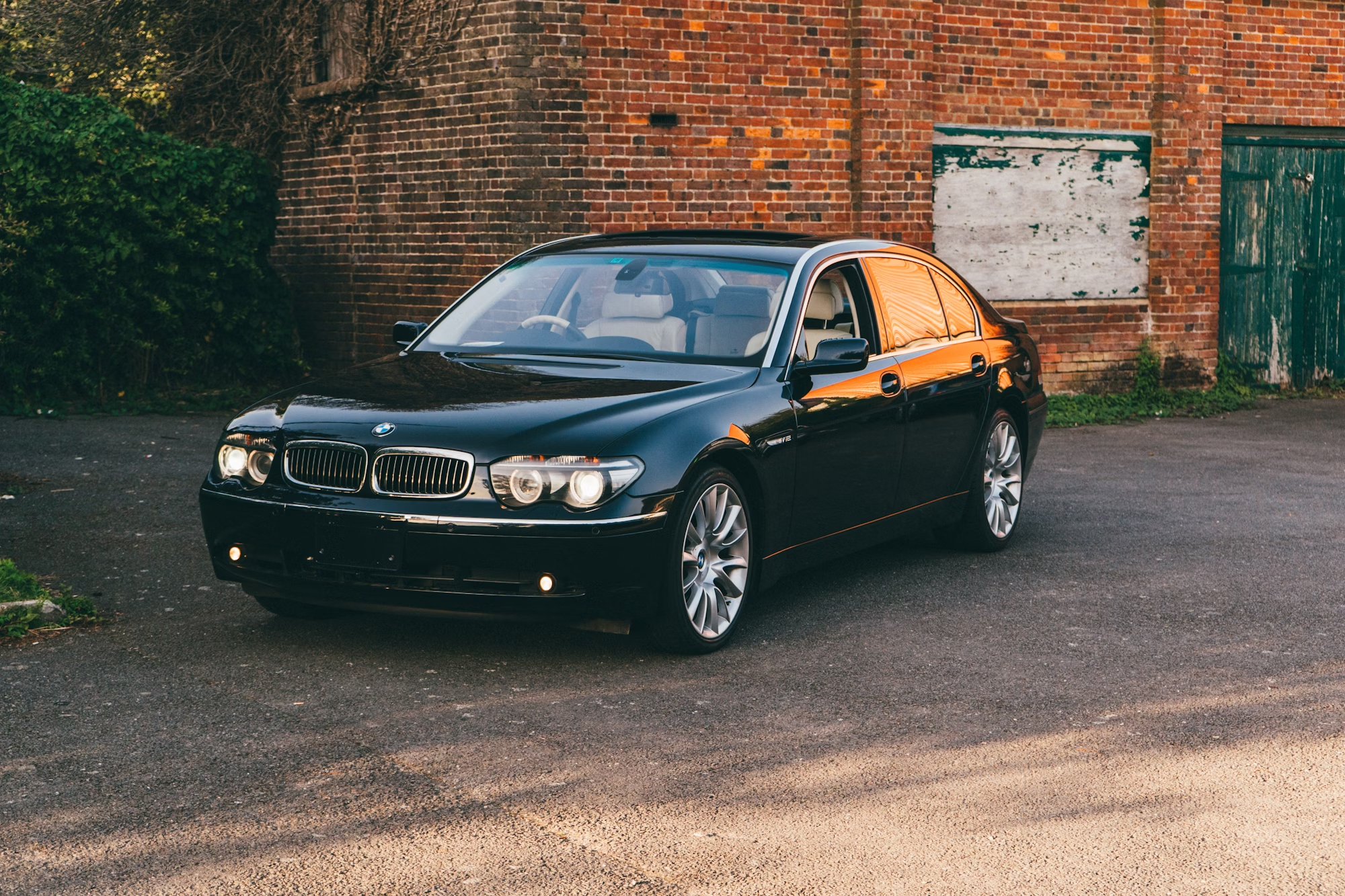
The E23 had already offered a substantial BMW sedan, including the turbocharged 745i in some markets. The E32 replaced its more upright proportions with a lower looking body and broader stance. In the 750iL, an additional 4.5 inches of wheelbase went to the rear passenger compartment. That extension was important: the car could retain BMW’s driver oriented layout without treating passengers as an afterthought.

The chassis combined front struts with semi-trailing rear arms and, on the 750iL, hydraulic rear self-leveling. The leveling system countered the change in ride height caused by passengers and luggage; it did not turn the rear suspension into an air spring system. A four speed automatic kept the power delivery continuous enough for the engine’s purpose. Neither component was the newest imaginable solution in isolation. Their calibration mattered more than the catalog description.
The original Car and Driver test nevertheless criticized the steering and noisy climate control. Those complaints belong beside the excellent performance figures. Speed dependent assistance can alter steering effort without improving the information reaching the driver, and a quiet engine is little consolation when the ventilation insists on conducting the conversation. The E32’s sophistication did not exempt its individual systems from ordinary judgment.

Inside, BMW kept the angled dashboard and recognizable controls while adding climate regulation, powered adjustments, and communications equipment around them. Electronic damping and insulating glass expanded the E32’s capabilities during its production life, with availability dependent on date and market. The resulting car could be highly elaborate without looking like an experiment from the driver’s seat. This restraint in the interface would later prove harder for BMW to preserve than smoothness in the engine.

Highline equipment carried the passenger brief much further. The refrigerator and tables were not advances in propulsion, but they changed the way the car could be used. A buyer no longer had to choose the V12 BMW solely because he intended to drive it. The rear cabin could support the same preference. The added equipment also brought more wiring, plumbing, electrical demand, and mechanisms into a car already distinguished by its complexity. Luxury had acquired a substantial service manual.

Factory protection brought another kind of load. Armor requires more than inserting heavy panels: glazing, hinges, suspension, brakes, and the surrounding structure have to remain compatible with the added mass. The V12 supplied useful reserve for moving the result without making every additional pound evident at the accelerator.

Against the W126 560SEL, BMW had a convincing new combination rather than a monopoly on quality. The Mercedes offered a mature body, substantial V8 performance, and a carefully developed luxury car. Its age became a disadvantage when buyers valued the BMW’s particular mixture of refinement and newer controls. It did not make every Mercedes virtue disappear. The competition was difficult precisely because the incumbent was good.

The Bentley Turbo R complicated the picture in another direction. Its turbocharged V8, upright accommodation, and distinctive cabin were not attempts to reproduce the BMW. Buyers could reasonably prefer that experience while conceding the E32’s more contemporary integration. What BMW threatened was not Bentley’s right to exist. The E32 threatened the assumption that a much higher price automatically bought a more accomplished machine.

The 750iL’s speed brought it into conversations previously reserved for sports cars, but a top speed does not make a sedan a substitute for one. Braking repeatedly, changing direction, shedding heat, and communicating tire load present different demands. The BMW’s achievement was to carry four adults quickly without asking them to endorse every compromise that made the sports cars entertaining.

Goldfisch and the limits of more
Goldfisch tested how far the cylinder argument could be extended. BMW’s engineers built a 6.6-liter V16 and installed it in an E32 experimental car. Four extra cylinders lengthened an already substantial engine enough to displace the normal cooling installation. The radiators went to the rear, where conspicuous ducts fed them through the bodywork. The prototype is a wonderfully direct illustration of packaging debt: the engine gains four cylinders, and the trunk receives the bill.

There is a difference between demonstrating that such a car can run and demonstrating that customers should buy it. Cooling performance, luggage room, noise, crash structure, assembly, and service access would all have needed production answers. The ducts were not merely a styling eccentricity. They were a visible record of what the new engine had displaced.

BMW built a second Goldfisch in 1990, with a different body and a more integrated installation. The two prototypes record successive attempts to accommodate the larger engine rather than a single finished car. Their existence is more revealing than a speculative top speed: BMW was spending real engineering effort on the question of whether the luxury sedan needed another four cylinders.

Goldfisch exposed the limits of the original proposition. More cylinders might improve some sensations, but their value had to exceed the cost of everything required around them. The E32 V12 had found a commercially workable balance. The V16 made the trade much harder to defend.

A Mercedes W18 proposal approached the same packaging problem through additional banks rather than an even longer conventional V. Shortening the engine would complicate crankshaft design, induction, exhaust routing, and cooling. Both ideas reveal how quickly the pursuit of a larger number could multiply the surrounding work. Neither reached production.

Meeting the competition
The production car needed none of that mythology. It had taken a configuration associated with specialist machinery and made it an expensive but recognizable BMW purchase. A V12 badge was no longer confined to the exotic corner of the market. The sedan’s ordinary silhouette made the mechanical extravagance more, not less, provocative.

The result demonstrated that the E32’s combination could survive direct comparison with quite different cars, not merely a sympathetic launch drive. The Lexus also posed a question that would outlast the test: how much should a customer pay for quiet, careful assembly, and agreeable daily operation? A V12 badge could identify an expensive answer without proving it was the only good one.

Mercedes’ M120 supplied a formidable alternative. It displaced 6.0 liters, used four valves per cylinder and double overhead cams, and powered a larger new S-Class. The launch European ratings of 408 PS for the Mercedes and 300 PS for the BMW show a substantial difference without mixing horsepower standards. Mercedes had chosen more output and more surrounding car. The larger, more elaborate Mercedes engine gave the rivalry a substantial mechanical foundation.

The W140 offered room, isolation, and an extraordinary concentration of equipment. Its size was an advantage from some seats and an inconvenience from others. BMW’s less monumental sedan remained attractive to someone who wanted the car to feel manageable from behind the wheel. By then the E32 had accomplished its most important task: the argument was no longer whether BMW belonged in this comparison, but which kind of excellent large car the buyer preferred.
The E31: the same engine, a different bargain

The 850i’s arrival at Frankfurt in September 1989 made BMW’s ambition visible in a way the sedan could not. The E32 was an expensive variation on a familiar silhouette. The E31 looked like a separate undertaking: low nose, retractable headlights, a broad glass canopy, and a long body that made little attempt to maximize the number of people inside it. BMW had found another use for its engine, and another way to spend the margin around it.

It was a grand tourer rather than an E32 with two doors removed. Its four seats did not confer the sedan’s rear accommodation, and its length did not make it a spacious family car. The body allocated room to the engine, the front occupants, and the long sweep of its profile. The buyer was purchasing a different relationship between distance, comfort, and appearance.

The shape remains compelling because its surfaces have work to do. The nose is low, the glass sits closely within the body, and the rear volume rises enough to make an aerodynamic termination without becoming a separate architectural event. The car looks substantial even when the lamps are down and most of its face has disappeared.

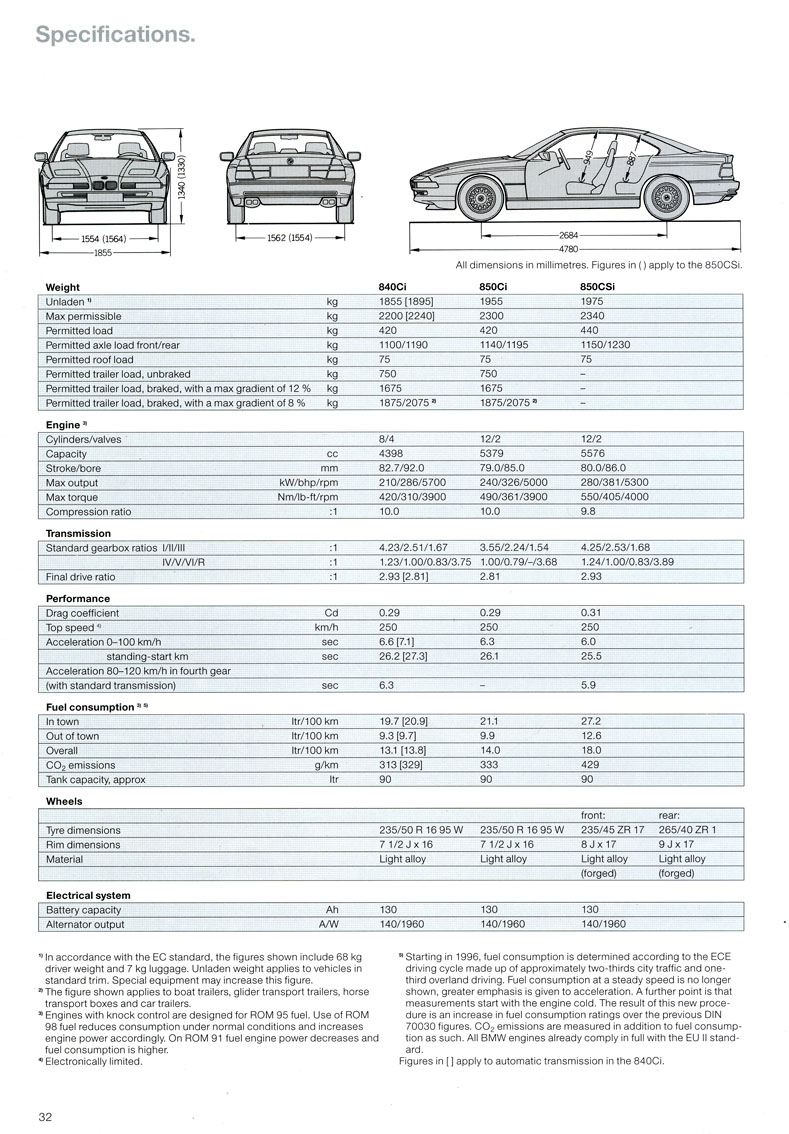
BMW quoted a drag coefficient of 0.29 for the ordinary E31, a useful achievement in a wide car intended for sustained speed. The number alone does not measure total drag, which also depends on frontal area, but it helps explain the care given to glass, seals, mirrors, and the body’s rearward flow. Aerodynamics supported the driving purpose: less power consumed pushing air, less disturbance around the cabin, and a shape that made its engineering legible without labeling it.

The M70 could be paired with a four speed automatic or a six speed Getrag manual. The manual mattered less as a route to a better brochure number than as a change in ownership of the experience. The driver could choose how the V12 entered a corner or gathered speed afterward, instead of asking the transmission to interpret the request. The same smooth engine now invited participation rather than merely relieving effort.

There was substantial competition. The Mercedes coupe offered space and a mature luxury formula; the Porsche 928 had spent years developing the front engine GT as a driver’s car; Ferrari sold a very different combination of engine character, body design, and expense. The BMW did not erase those distinctions. It added a particularly technical and visually modern answer, one whose performance came with more insulation than some enthusiasts expected from the shape.

A low, exotic looking coupe suggests immediacy. A heavy, thoroughly equipped grand tourer delivers stability and comfort at a cost in agility. The E31 carried enough mass that the original M70’s output did not turn every acceleration into an event. Its sophistication was easier to appreciate over a long journey than in a short demonstration intended to prove that an expensive BMW was faster than something cheaper.

The generous front accommodation, integral seatbelt arrangement, and complex side glass illustrate where some of the money and weight went. Removing a pillar is not simply deleting a piece of metal. Loads have to find other paths, seals have to remain aligned, and the seats acquire structural responsibilities. The resulting openness is lovely. It is also an engineered condition that an aging car must continue to maintain.

Eight cylinders, then a larger twelve
The V8 840Ci, introduced in 1993, tested how much of the car’s attraction actually depended on 12 cylinders. It preserved the shape, accommodation, and general touring purpose at a lower position in the range. That was not a dilution so much as a useful experiment. An owner who cared more about the car than the engine badge could acquire most of the proposition without buying its most elaborate powertrain.

The V12 nevertheless remained the E31’s defining engine. Its long banks and paired intake systems gave the engine bay a visual order that matched the car’s deliberate surfaces. Underway, its appeal depended less on being constantly spectacular than on remaining smooth while the car covered distance. The V8 alternative made that preference clearer by offering so much of the same grand tourer without it.

BMW’s naming change and engine change occurred separately. The 850Ci designation appeared while the 5.0-liter M70 was still fitted. The 5.4-liter M73 followed in 1994, with a five speed automatic, more torque, and revised valve gear. A later badge is therefore not an adequate substitute for checking the actual car. Even a flagship occasionally requires someone to read past the trunk lid.

The M73’s larger displacement and lower friction roller rocker arrangement improved the original idea without changing its basic architecture. It retained one camshaft per bank and two valves per cylinder. More ratios let the transmission choose a more suitable engine speed without relying on a large jump between gears.
Ferrari’s 412 was nearing the end of a long development line when BMW arrived. The E31’s new body and electronics made an immediate contrast with that familiar shape, but the later 456 would offer a much more modern Ferrari answer. The BMW’s advantage was partly timing: it entered while several expensive coupes were approaching replacement.

The next generation of rivals made the distinctions sharper. Ferrari’s 456 emphasized a more sporting interpretation of the front engine V12. Bentley’s Continental R paired a turbocharged V8 with great scale and a highly individual cabin. The Aston offered another tradition altogether. The 850i could look more contemporary than one and less demonstrative than another without defeating either on every criterion. Its strongest claim was to a particular combination, not universal supremacy.

The E31 occupied an awkward commercial position. Its substantial price and limited rear accommodation narrowed the audience, while its weight made it less urgent than the exotic shape might suggest. Buyers who wanted a sports car could find sharper ones; buyers who wanted a limousine had little need for the smaller cabin. Its strongest audience was the driver who specifically wanted the distance between those two categories.
Motorsport took the brief apart

The 850CSi gave the coupe a more forceful response. Its S70B56 enlarged the M70 concept to 5.6 liters and retained the single cam, two valve arrangement, but revised the breathing and calibration. BMW’s European specification listed 380 PS and 550 Nm, approximately 375 hp and 406 lb-ft, with a six speed manual as the only transmission. The suspension, steering, brakes, and exterior details received corresponding attention. The badge understated a substantial Motorsport intervention.

The experimental M8 went much further. BMW’s retrospective describes a 6.0-liter V12 with four valve breathing, carbon fiber intake hardware, and roller throttles that cleared the intake path at full opening. BMW quotes 640 metric horsepower for the prototype. Its intake and lighter construction suggest how different the result might have been from an ordinary 850i, but the company did not record official acceleration measurements. BMW eventually displayed it publicly rather than building it for customers.

Gordon Murray’s McLaren required a different answer again. The S70/2 was designed for a very light road car with demanding length, weight, response, and lubrication requirements. Its 6.1 liters, four camshafts, four valves per cylinder, individual throttles, and dry sump put it in a different mechanical category from the 850CSi’s two cam engine. The shared S70 nomenclature records a relationship within BMW Motorsport; it does not turn one design into a lightly modified version of the other.

The dry sump helped keep the engine low without sacrificing oil supply under cornering loads. Individual throttles reduced the intake volume that had to fill when the driver opened them, helping the engine respond quickly. High speed breathing produced the famous 627 bhp, but Murray also required tractability in ordinary traffic. That combination is the interesting connection to the sedan program: very different hardware, still expected to behave properly when it was not performing for an audience.

The competition chronology is equally distinct. A McLaren F1 GTR won Le Mans in 1995 with BMW power; BMW’s own V12 LMR won in 1999. The racing developments associated with the S70/3 required endurance lubrication, cooling, and regulation specific tuning, not merely more output. The X5 Le Mans then demonstrated how startling the same expertise could become when assigned an inappropriate silhouette. A racing V12 beneath an SUV hood is an excellent way to ensure that nobody mistakes a feasibility study for a sensible product proposal.

Italdesign provided a more conventionally exotic setting. The 1991 Nazca M12 placed the 850i’s 5.0-liter V12 amidships in a light composite concept. The 1993 C2 Spider used an engine from the 850CSi program. These were direct applications of production related engines, unlike the bespoke McLaren unit. Moving the engine into a lighter body exposed possibilities that the fully furnished BMW coupe deliberately traded away.

The E31 and its surrounding experiments demonstrate the range of BMW’s V12 ambitions, but also their boundaries. A grand tourer, a supercar, and an endurance racer do not become excellent through the same choices. The luxury sedan’s next step was less spectacular and more commercially important: improve the familiar car without asking it to become something else.
The E38: refinement, with competition attached

The E38 signals expense through proportion before the engine starts. The glasshouse sits lightly over a body with very little unnecessary emphasis. The grille, lamps, and wheel openings belong to the same scale. It looks expensive without looking enlarged for the purpose. Arriving in 1994, the new 7 Series could afford to develop the E32’s argument instead of repeating its introduction.

Navigation, communications, and later safety equipment entered a cabin still organized around recognizable controls. That continuity was a considerable asset, though it should not be romanticized into perfect simplicity. There were enough switches and operating modes to keep a new owner occupied. Functions multiplied, but the physical layout remained familiar.

The M73 brought 5.4 liters and, in U.S. specification, 322 horsepower and 361 lb-ft, paired with a five speed automatic. Motor Trend’s 1996 test recorded 6.4 seconds to 60 mph. The character mattered more than the tenth: the enlarged engine and additional ratio reduced the sense that a request for speed required a change of occupation. In a well sorted V12 sedan, velocity could become an administrative detail.

The E38 also put the engine’s quiet into a more thoroughly isolated setting. Insulating door glass and substantial acoustic treatment reduced competing sources of disturbance. The seat adjustments included support for the upper back, not merely a choice between upright and reclined. Such details explain why the car could feel more accomplished without producing a dramatic new headline. Refinement often consists of removing the third or fourth irritation, after the obvious one has already gone.

The M73’s conservative two-valve architecture delivered low-speed torque and refinement, but rivals increasingly used more elaborate breathing and control systems. BMW had not adopted four valves per cylinder simply to match Mercedes. It kept an engine well suited to modest operating speeds and improved the parts that served its intended use. Roller rockers reduced friction, displacement supplied torque, and later emissions revisions kept the design viable. None made the engine modern in every possible respect. They made it better at its particular job.

The chassis change was more fundamental than the familiar outline suggested. The E38 used a multilink rear suspension, giving the engineers more freedom to manage wheel movement than the E32’s semi-trailing arms. Electronic damping and rear self-leveling on the V12 helped reconcile passenger comfort with body control. The car could respond firmly without requiring one fixed compromise for every road and load.

Sport packages made the driver oriented side of the car more explicit, but they did not confer it for the first time. Nor did larger wheels automatically improve a luxury sedan. Tire compliance, damping, and road surface still determined what reached the occupants. The particularly handsome late cars on M Parallel wheels invite enthusiasm; that enthusiasm need not become a claim that every more aggressive specification was better to live with.

The more serious test comes with age. The engine may remain beautifully smooth while neglected suspension joints, tired mounts, leaking hydraulic components, or malfunctioning accessories undermine the rest of the experience. Duplicate ignition hardware and a densely equipped cabin do not become inexpensive because the car depreciates. Purchase price and the cost of sustaining the original behavior eventually part company. This is the ownership qualification the V12’s admirers owe it: durability of the basic design is not immunity from maintenance.

The High Security variants carried the same unobtrusive shape into a much more demanding role. Armor changed the mass, glazing installation, and loads imposed on the chassis. Factory development allowed these changes to be addressed together. The V12 supplied the reserve to move the result without making every additional pound evident at the accelerator.

The L7 pushed accommodation in the opposite direction from the 8 Series. The extra length gave the rear compartment more scope for limousine equipment while preserving the recognizable BMW body. It extended the platform toward buyers whose principal relationship with the car began at the rear door. BMW was learning to serve more than the executive who drove himself.

Before that, the immediate comparison remained with Mercedes. The W140’s size bought genuine room and a distinctive sense of separation from the road. The E38’s proportions and chassis calibration made a different promise to the person holding the wheel. Neither preference can be deduced from the number of valves. The BMW’s appeal was the sensation that the car remained a manageable object rather than a room temporarily moving between buildings.

The magazine’s main ranking put the 750iL ahead of the S500 and XJ12. Its S600 sidebar recorded 6.0 seconds to 60 mph and 14.5 seconds through the quarter-mile, against the BMW’s 6.3 and 14.8. The V12 Mercedes was also markedly more expensive. The BMW’s victory was a judgment about the complete car and its price, not proof that the fastest V12 had come from Munich.

Jaguar retained a lovely ride and an attractive cabin, but its low body constrained accommodation while the newer Germans offered more space and increasingly elaborate chassis and safety systems. The successive Series III, XJ40 based XJ12, and X300 carried the engine through a rapidly changing competitive landscape. Its softness and shape remained attractions; they were no longer sufficient to keep the V12 sedan at the center of the market.

Lexus posed the deeper question. A carefully developed V8 could make a sedan remarkably quiet and smooth without the cost and packaging of 12 cylinders. That left the BMW defending the quality of its power delivery under load, its chassis behavior, its equipment, and the appeal of the engine itself. None was worthless. None entitled the V12 to claim exclusive ownership of refinement.

Rolls-Royce and Bentley, meanwhile, sold craft, atmosphere, and continuity as well as transport. Comparing them only by acceleration would be as incomplete as comparing the BMW only by the quantity of veneer. Nevertheless, a traditional cabin could not indefinitely conceal the need for a new generation of mechanical and electrical systems. That development required money and engineering capacity, not simply confidence in the clientele.

The Bond car captured a real shift even while exaggerating it. A large luxury sedan had become a place where electronics could be expected to do something novel. BMW’s achievement was not that every new function proved useful. It was that technical capability had become inseparable from the car’s public identity. The next generation would discover how far that expectation could be pushed before the occupants objected.

The E38 therefore occupies a more interesting position than “the last good one.” It preserved familiar forms while integrating enough technology to complicate that familiarity. Its engine had become smoother and more useful, but alternatives had become better too. The car’s appeal survived because the whole package worked for a particular kind of buyer, not because 12 cylinders had settled the luxury question permanently.
When Rolls-Royce became a customer

The 1998 Silver Seraph supplied the most concrete answer to BMW’s original claim. Its 5.4-liter M73 came from the same engine family as the 750iL’s. Rolls-Royce had selected a BMW V12 for its new sedan before BMW operated Rolls-Royce Motor Cars. What would once have sounded like an impudent comparison had become procurement.

The engine supply arrangement did not make the Seraph a rebadged 7 Series. Crewe still had to develop the car around the powertrain: structure, suspension, isolation, cabin, and the particular controls through which its owners experienced the machinery. An engine can be sufficiently refined for a Rolls-Royce without making every car containing it a Rolls-Royce.
The related Bentley Arnage initially used a different BMW engine, the 4.4-liter M62 V8, with twin turbocharging developed with Cosworth. Rolls-Royce received the naturally aspirated 12; Bentley received the turbocharged eight. Modernization did not require both marques to make the same mechanical choice, even while sharing a new body family.

Then the supplier relationship became entangled with the sale of the business. In July 1998, Volkswagen acquired the Rolls-Royce carmaking companies from Vickers. The transaction brought the manufacturing operation and Bentley into Volkswagen’s orbit. It did not bring unrestricted ownership of every right associated with the Rolls-Royce name. The company, the factory, and the trademark were not the same asset, however conveniently the showroom had made them appear so.

BMW obtained the automotive name and marque rights separately from Rolls-Royce plc. Under the resulting arrangement, the Volkswagen owned carmaker could use them through December 31, 2002; BMW would have full use from January 2003. The European Commission’s contemporary merger decision records that division explicitly. Volkswagen retained Bentley. BMW had the name with which to establish a new Rolls-Royce operation. The stationery had proved more consequential than the furniture.

The transition allowed production to continue while the companies separated their plans. Existing cars still depended on supplied engines and components; the future products needed their own development programs. Volkswagen could develop Bentley around the existing Crewe operation, while BMW had to build a new manufacturing home and a car worthy of the name it had secured. Each had acquired an opportunity with considerable work attached.

Bentley subsequently returned the Arnage to the long serving 6.75-liter V8 in Red Label form. This was not simply putting tradition back where a foreign engine had been. A different engine and transmission changed the mass, torque delivery, cooling, and demands on the rest of the car. The older architecture could deliver the low speed thrust Bentley buyers valued, but installing it required substantial engineering rather than a change of engine cover.

That divergence was healthy for the identities of the two marques. Bentley’s later Volkswagen Group W12 products would pursue a compact 12 cylinder package with turbocharged performance. Rolls-Royce would retain a conventional V12 and concentrate its development on the removal of effort. Neither path can be judged merely by the nationality of the engine supplier.

Shared switchgear was more awkward because it touched the customer’s sense of exclusivity directly. A familiar climate control panel can reveal common sourcing faster than a sophisticated engine hidden under a cover. Yet a bespoke button that operates badly is not inherently more luxurious than a shared one that works. The difficult task is to borrow engineering without making the finished car feel assembled from recognizable donor parts.
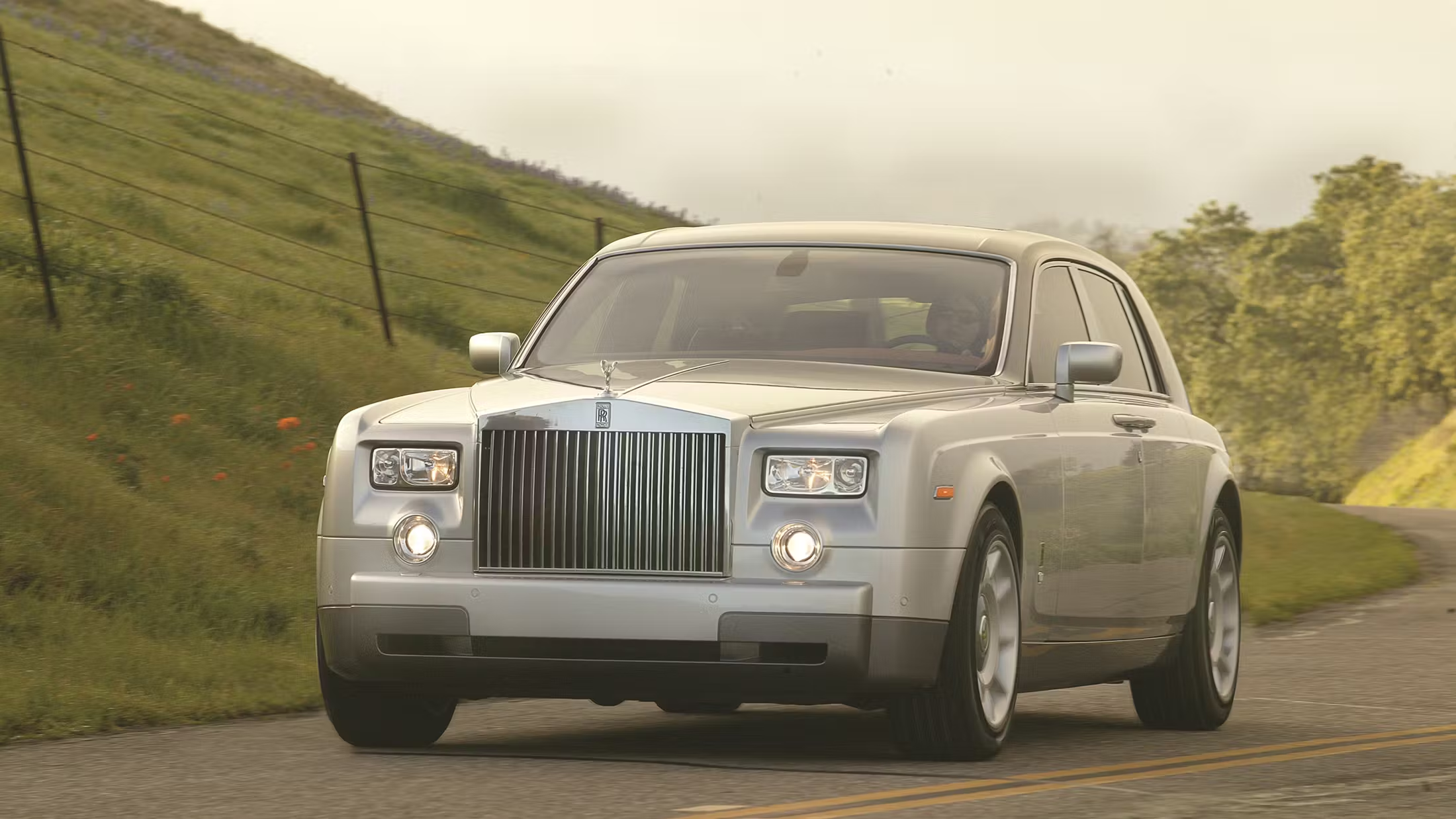
BMW’s new Phantom made that distinction unmistakable. It was a large, formal car built around an aluminum spaceframe, not a 7 Series body in more expensive clothes. Its 6.75-liter V12 belonged to the N73 generation of BMW engineering but served a different installation and calibration. The scale, seating position, doors, and relationship between body and wheels established a separate object before anyone opened the hood.

Its real achievement was to make new technology support an old expectation: the car should respond without making its occupants supervise the process. A controller and screen could be hidden or subordinated to the cabin, but their operation still mattered. Rolls-Royce was not exempt from the interface problem simply because its dashboard contained more wood. Concealing the machinery was part of the design brief, not a substitute for finishing it.

The original Ghost later used more direct architectural connections to BMW’s F01/F02 generation, together with an enlarged twin turbo V12. Sharing extended beyond the engine family to the underlying platform, while leaving considerable scope for the body, suspension, isolation, and cabin to differ. The borrowed architecture was a starting point rather than a complete set of instructions for the finished car.

Within the group, the exchange also made it possible to spread costly powertrain expertise across cars selling at very different prices. The same investment can support several interpretations of luxury, provided the cheaper one does not make the dearer one feel redundant. By then, BMW’s V12 had become both a product and an internal resource.

The supplier reversal is thus more revealing than a simple takeover story. The M70 had helped establish BMW’s credibility at the top of its own market. The M73 was good enough to be chosen by Rolls-Royce. Later engines helped support a separate Rolls-Royce range. That did not make the British design and manufacturing work incidental. It showed what BMW’s investment could enable when someone else’s definition of the finished car was allowed to govern the result.
The E65: progress asks for your attention

BMW’s next 7 Series presented a harder case for anyone inclined to equate technical ambition with better luxury. The E65 and long wheelbase E66 appeared in 2001; the N73 powered 760i and 760Li followed later. The new car replaced the E38’s low, continuous forms with a taller body, a more emphatic rear volume, and a cabin organized around a different control philosophy. It was possible to admire what lay beneath the surface and dislike almost every encounter with the surface itself.

Under Chris Bangle’s design leadership, Adrian van Hooydonk’s exterior broke decisively with the preceding car. The raised deck looked applied rather than smoothly continued from the body beneath it. That visual interruption made the car memorable, but memorability is not the same as grace. A buyer who preferred the E38 did not necessarily misunderstand progress. He might simply have preferred proportions that did not require an explanation.

The later Mercedes W221 also acquired a pronounced rear volume, though the treatment belonged to a different overall design. Large sedans were becoming taller and more visually emphatic. BMW’s break was particularly abrupt because the E38 had made so few demands on the eye. The new car announced its difference before anyone had encountered the electronics responsible for much of it.

Inside, iDrive moved many functions from dedicated controls to a high screen and rotary controller. The dashboard no longer wrapped itself around the driver in the old manner. A column mounted selector freed the console for iDrive. Information appeared on a high screen, while the hand worked a controller lower down. This separated viewing from reaching, a sensible objective in a moving car. It also separated familiar actions from the controls people already knew how to use.

Software itself was not the liability; burying frequent adjustments in menus was. Navigation and communication functions already required displays and menus. A rarely adjusted setting can reasonably live several steps into a menu. A frequent adjustment should not require the driver to reconstruct the current state of the interface while traveling at highway speed. Visual tidiness in the dashboard is not free when the displaced complexity moves into the driver’s attention.
The engine makes its case
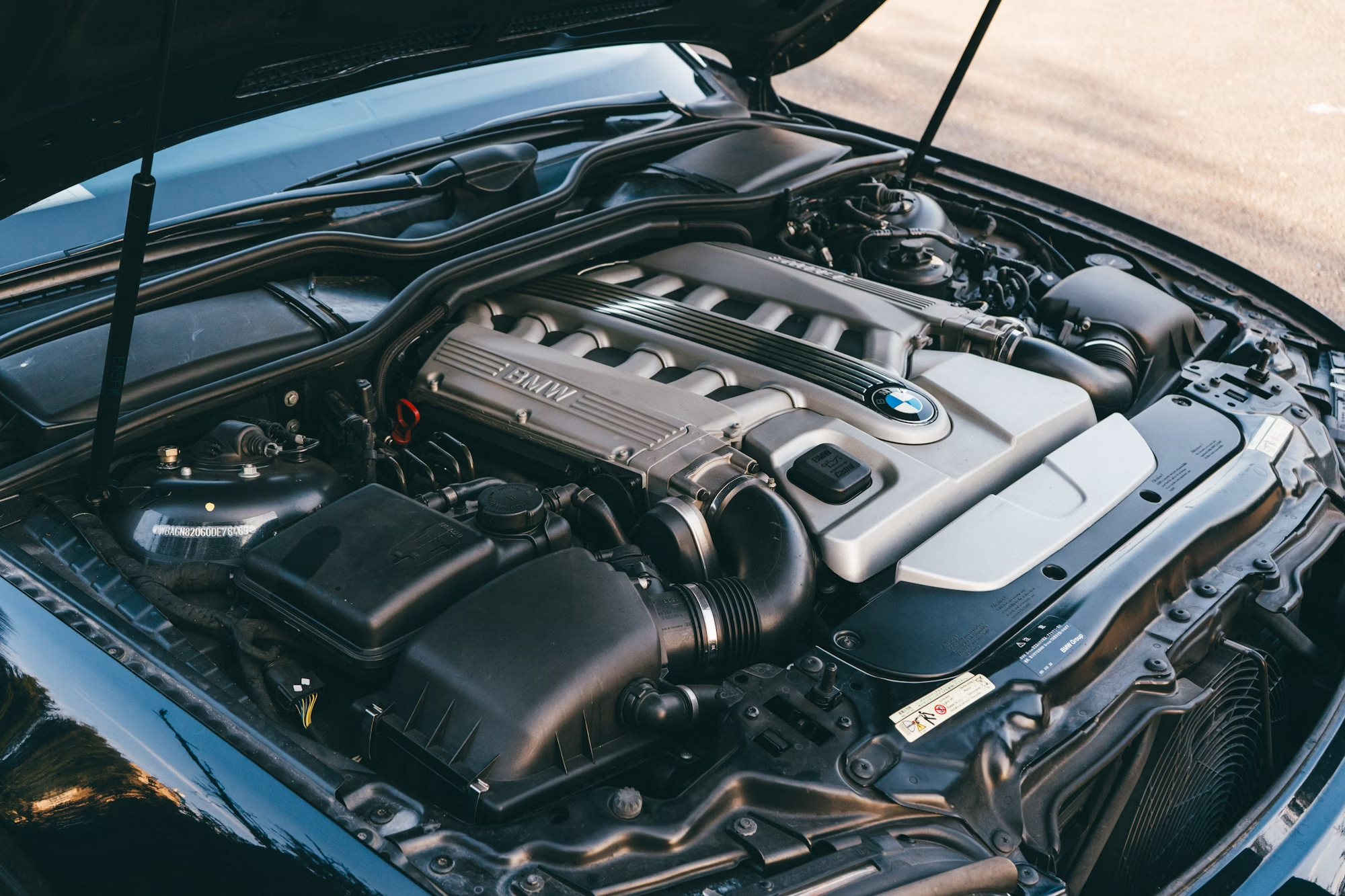
Mechanically, the 760Li made a far stronger case. The 6.0-liter N73 combined double overhead cams and four valves per cylinder with direct injection, variable camshaft timing, and Valvetronic. Direct injection placed the fuel in the combustion chamber. Valvetronic varied intake valve lift to control the air charge, reducing reliance on throttling the intake. These were separate systems addressing different parts of the engine’s operation, not three marketing names for the same device.
The U.S. launch rating was 438 horsepower, rather than the 445 metric horsepower often quoted without qualification. The new engine’s greater breathing capacity supported substantially more output than the M73, while variable valve control helped it remain tractable below full load. BMW had moved from a comparatively conservative V12 valvetrain to a remarkably elaborate one. The improvement was real; so was the increase in mechanisms, actuators, and diagnostic work around it.
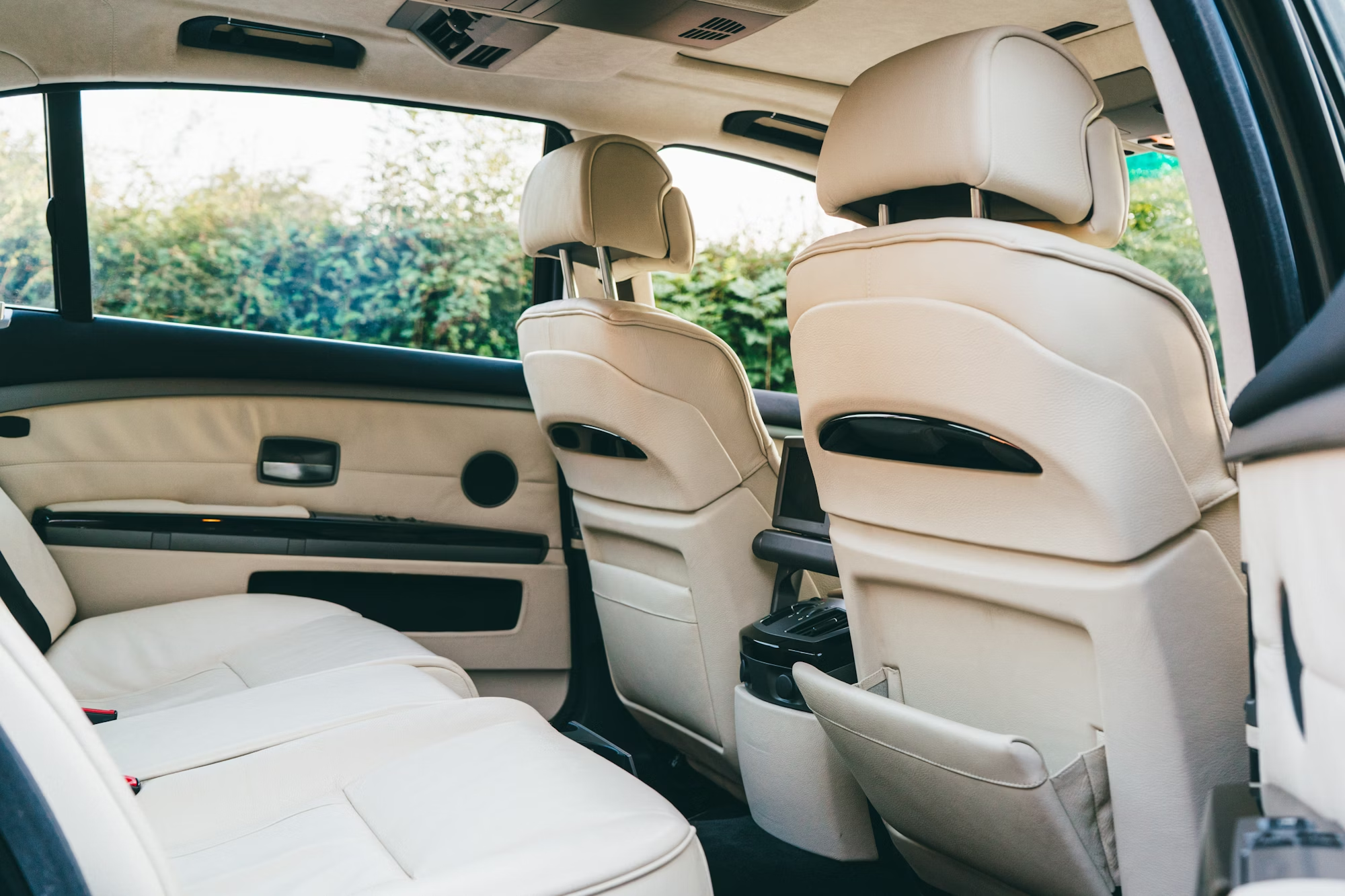
The six speed automatic had already appeared in the V8 7 Series before the V12 arrived. Its additional ratios helped reconcile acceleration with a low engine speed at cruise. Dynamic Drive active anti-roll control addressed another longstanding compromise: a car could resist leaning in a bend without depending entirely on stiff passive roll bars. Electronic damping and rear air leveling completed a chassis that attempted to distinguish a corner from a bump rather than responding to both with the same firmness.

Mercedes’ move to a twin turbo V12 supplied a less intricate route to very large torque, while BMW pursued natural aspiration and valve control. Neither solution made the other unserious. BMW could offer a progressively building response without boost; Mercedes could produce greater output and effortless thrust at lower engine speeds. The debate was becoming one of method rather than whether a luxury flagship should be fast.

The W12 was a different packaging solution again. Its two groups of narrowly staggered cylinders allowed a shorter engine around a common crankshaft. That mattered when a large engine had to coexist with a front differential and the surrounding crash structure. The resulting intake, exhaust, and cylinder head arrangements were complicated, but calling the configuration less dignified explains nothing. A crankshaft has no opinion about the social standing of the cars sharing it.

Shared architecture did create a branding problem. A Continental and a Phaeton could not sell the same experience at the same price, however useful their common engineering might be. Shared architecture made brand differentiation depend on the complete vehicle rather than exclusive hardware. BMW faced the same obligation with Rolls-Royce, and the existence of a conventional V12 did not automatically make its solution purer.

Toyota’s Century further weakened any claim that 12 cylinders belonged to a uniquely German idea of the flagship. Its priorities centered on the rear passenger, smooth operation, and continuity rather than a sporting public identity. The configuration could serve that purpose as well as BMW’s. It was a mechanical resource, not an instruction to design every surrounding car alike.

When the interface gets in the way
iDrive’s first execution gave the broader BMW argument a necessary test. The M70 had used electronics to make the engine easier to live with. An interface that made a routine action harder moved in the opposite direction. Both might be technically ambitious. Only one reduced the occupant’s workload.

There was a genuine advantage to having one place from which to manage a growing number of functions. There was also a genuine cost when the same knob changed meaning according to the screen. Physical controls can be learned spatially: the hand knows where a function lives. A menu requires the eye to confirm where the software has taken it. Familiarity can reduce that cost without making it disappear.

Later central displays and rotary controllers show that BMW correctly anticipated the need to organize growing digital functions, while shortcut buttons, faster software, and retained physical controls show how much the first execution needed refinement. Those changes were revisions to the concept, not evidence that frustrated early owners had been wrong all along.
Nor did the excellent engine cancel the interface. A car can accelerate beautifully while making its driver irritated before leaving the driveway. That combination is especially damaging in a flagship sold on the removal of effort. The E65’s significance lies partly in exposing a distinction the industry would keep trying to obscure: a larger technical capability is not necessarily a better interaction.
The 745i placed third behind the Lexus LS430 and Jaguar XJ8 despite strong performance. The magazine objected sharply to its controls. These were not V12 engine judgments, but they were judgments about the same generation’s approach to luxury. The machinery could win at the track while the car lost points for dealing badly with people.

The car found customers despite the objections, and the facelift moderated its appearance. Neither development made the initial control problems disappear. They show instead that buyers could value the engine, chassis, space, or newness strongly enough to accept the irritation. A car does not need to be a commercial disaster for a particular design decision to be wrong.

The E65 left two legacies. Its engine and chassis showed how much could be gained from coordinating increasingly sophisticated systems. Its interface showed what happened when the coordination stopped at the occupant. BMW’s next V12 sedan would preserve the first lesson and make a visible attempt to absorb the second.
The F01: boost replaces the argument

The 7 Series introduced in 2008 looked like BMW had finished an argument with itself. Its surfaces were calmer, its proportions more familiar, and its controls less determined to make every previous owner a beginner. The V12 followed in 2009, reaching the United States as the 2010 760Li. Under that comparatively sober body, BMW changed its approach to the engine more substantially than the styling suggested.

The N74 retained the 60-degree layout, four valves per cylinder, and direct injection, but added boost. Where the N73 had enlarged the naturally aspirated engine’s breathing capacity, the N74 increased the amount of air entering it under pressure. The result was substantially more torque available much earlier, reducing the need to reach high engine speeds before a large acceleration. That suited a limousine better than a peak power figure alone could suggest.

Compressing air heats it, reducing its density and increasing the tendency toward knock. The N74 therefore used charge coolers with a separate coolant circuit. Its turbos sat outside the cylinder banks rather than inside the V. Valvetronic was absent, although variable camshaft timing remained. This was a different collection of compromises, not simply an N73 with two extra devices attached. Boost saved no one the work of managing combustion, heat, or throttle response.

The accompanying eight speed automatic mattered almost as much. More ratios gave the transmission more ways to place the engine in its useful range; electronic coordination could then smooth the handover between gears and boost. In its 2009 drive, Car and Driver observed normal second gear starts and rapid multiple ratio downshifts. Those are two ends of the same brief: avoid a lurch when leaving the curb, but do not hold a long conference when the driver asks to pass.

That response could be more useful than the earlier V12’s willingness to rev. A luxury engine spends much of its life below its maximum output, moving a considerable mass without announcing each adjustment. A broad torque delivery allows small changes in speed with smaller changes in engine speed. It also creates a new problem when the accelerator calibration delivers too much too suddenly. Turbocharging increases the available force; refinement depends on how accurately the driver can request it.

The F02 combined this powertrain with a long cabin, substantial insulation, and chassis systems descended from the E65’s attempt to reconcile ride with body control. It was not a return to an analog BMW. The more familiar interface merely made the technology less conspicuous. That was an improvement precisely because the driver no longer needed to admire the system in order to operate the car.

The Mercedes S600 and S65 supplied credible alternatives on either side of the BMW’s intended temperament. Greater output did not settle the comparison, any more than the BMW’s quieter presentation did. Accelerator response, transmission decisions, ride, seating, and noise under load determined how the capacity was experienced. By this stage, the contest had moved well beyond whether 12 cylinders could make a sedan fast.

Sharing the engine family with Rolls-Royce gave BMW a broader base over which to develop it. In the heavier Ghost, the V12’s value was its ability to accept greater mass and different gearing without making the powertrain conspicuous. The V12 still offered a particularly agreeable starting point for that work. Sharing a starting point was not the same as sharing a finished car.

Meanwhile, the V12’s competition was moving inside the same showroom. Turbocharged V8s could deliver immense torque in a shorter package with fewer cylinders to feed and service. Electric assistance offered another way to supplement combustion at low speed. Neither development erased the V12’s balance, but both weakened the claim that its particular complication was necessary to obtain effortless acceleration.

The old expense also remained. Two banks of cylinders, turbochargers, charge cooling, fuel systems, and densely packed auxiliaries had to age somewhere beneath the sound insulation. Their failure rates cannot be inferred from the number of parts, but their repair does not become cheaper because the car has depreciated. An owner can acquire the flagship for a fraction of its original price without acquiring a corresponding discount on the work required to keep it a flagship.

The F02 thus left the V12 with a more exposed purpose. It no longer had an exclusive claim to exceptional performance, and it had never held an exclusive claim to quiet. What remained was a particular combination of firing regularity, response, sound, and reserve. The next generation made the V12 much faster while V8s and electric motors continued closing the gap in the qualities that once justified twelve cylinders.
The G12: the last distinction

The last V12 7 Series arrived with an M in its name and drive to all four wheels. Both changes mattered. M Performance branding made acceleration a more explicit part of the sales pitch, while xDrive gave the engine a better chance of turning its output into forward motion instead of an intervention from the traction control system. The American name shortened to M760i, but the car retained the long G12 body.

That body used Carbon Core construction, combining carbon fiber reinforced plastic with aluminum and high strength steel. The value lay in putting different materials where their properties were useful, rather than making the entire sedan from the most fashionable one. A lighter, stiffer structure can reduce the burden on springs and dampers while providing firm mounting points for them. It cannot repeal the mass of the engine, equipment, passengers, or the increasingly large wheels.

The larger N74 remained a twin turbo V12 with direct injection and variable camshaft timing. The change from the F02 was less a new combustion principle than an expansion of its useful output, coupled to a chassis better able to deploy it. The M760’s acceleration depended on transmission, tires, torque management, and all-wheel drive as much as the V12’s peak output.

BMW’s alternative Excellence specification made the competing purposes unusually explicit. It exchanged the M Performance exterior treatment for more chrome and different wheels, and adopted a quieter exhaust character. Underneath remained the same extraordinary capacity. One customer could ask the car to advertise it; another could pay for the option of not explaining it. The second was closer to the original 750iL’s public manner.

Air suspension on both axles, active roll control, and rear wheel steering helped the M760 manage a body that remained very large. Air springs maintained ride height as the load changed. Active roll control could resist cornering lean without requiring equally stiff passive behavior everywhere. Rear steering altered the car’s response and maneuverability. These were different tasks, and their coordination mattered more than the number of systems available to be printed in a brochure.

The facelift’s mechanical changes were less conspicuous than its grille. For the 2020 U.S. car, BMW quoted 600 horsepower and 627 lb-ft, with a claimed 3.6-second run to 60 mph. Torque had risen from the early M760’s 590 lb-ft. More awkwardly, BMW’s same announcement gave the V8 750i xDrive a 3.9-second time. The smaller engine had brought the acceleration argument uncomfortably close to home.

The rear driven S65 and all wheel drive BMW also exposed the limits of ranking engines by standing starts. Greater torque does not guarantee a quicker launch when two tires must deliver it. Conversely, superior traction does not demonstrate superior engine refinement. The M760’s ability to repeat a fast departure was a genuine benefit of the complete car, not proof that its V12 was uniquely capable of producing the necessary power.

There were more everyday questions than the launch stopwatch could answer. How well did the seat support its occupant after several hours? Did the car absorb a broken surface without a second body movement? Could a passenger adjust the shade without first diagnosing the tablet? The G12’s rear controls sometimes offered several ways to do the same thing. Redundancy is more welcome here than compulsory menu navigation, although the extra interface was not itself evidence of extra comfort.

Alpina made the alternative particularly difficult to dismiss. A B7 did not need 12 cylinders to combine enormous speed with a carefully developed ride and a distinctive cabin. Nor did the V12 automatically make the M760 the more satisfying car on a particular road. By now, choosing it meant valuing its specific power delivery and mechanical character enough to accept its cost and packaging. That is a more credible defense than pretending the V8 had failed to qualify.

Quietness can still be character. A regularly firing engine whose response builds without a coarse change in tone communicates something different from an engine that stages a performance at each throttle opening. Neither experience is empty. In the BMW, the pleasure lay in how little disturbance accompanied the demand. The car was not obliged to imitate a Lamborghini simply because the cylinder counts agreed.

That preference rested on the combined response, sound, and suppression of vibration, rather than an ability to count combustion events from the passenger seat. Mechanical enthusiasm need not take the form of volume, and reserve need not be confused with indifference. The M760’s problem was commercial: other powertrains could now satisfy most of the same requests, while the differences it retained appealed to fewer customers than the costs of developing and certifying it might suggest.
A car becomes a commemorative object

BMW’s centenary edition in 2016 dressed the car in Centennial Blue and Smoke White leather, but its 100-car total covered several 7 Series powertrains, not 100 V12s. The V12 sat at the top of the anniversary range rather than claiming the entire celebration for itself.

The matching pen was real. It was also more revealing than another increment of horsepower: the car was being presented as an object to select, specify, and preserve, with even the correspondence brought into the color scheme. Apparently an ordinary signature risked lowering the tone.

The anniversary editions shared an interest in surface, material, and ceremony. They did not require new mechanical achievements to justify their place. The 40 Jahre cars offered specially selected finishes and trim, while allowing the customer to choose among the range’s engines. 12 cylinders remained the most elaborate choice rather than the only route to the occasion.

The two-tone cars carried the idea further toward Rolls-Royce territory. A body that had once made its strongest impression through understatement could now be ordered as a much more conspicuous object. This was not a contradiction BMW needed to resolve. The same machinery could serve an owner who wanted anonymity and one who wanted his particular anonymity divided by a contrasting coachline.

The actual farewell came with BMW of North America’s January 2022 announcement of 12 Final V12 cars for the United States. Those 12 were a commemorative allocation, not the entire final worldwide production run. BMW specified unique identification, Individual finishes, and a personalized commemorative gift, with an announced price of $200,000 before destination and applicable taxes. Production was scheduled for June. A cylinder count that had once been a regular entry in the price list had become the organizing principle of a keepsake.
A single auction cannot establish the edition’s future value, but its commemorative purpose was already clear at delivery. BMW no longer needed to prove that the V12 could produce enough performance or that the car could be lavishly equipped. It was marking the departure of a particular way of doing the job.

The retreat was not caused by the M760 being insufficiently dramatic. Developing an engine requires investment in combustion, emissions control, thermal management, manufacturing, and certification, whether it appears in a few cars or many. Sharing work with Rolls-Royce could spread some of that burden without eliminating the separate requirements of a BMW installation. Meanwhile, powerful V8s, hybrids, and electric motors offered other ways to provide the response for which customers had once paid for 12 cylinders.

Nor does the survival of sporting V12s defeat that explanation. A supercar can sell the engine’s sound, rev range, and visibility as central parts of its appeal. A limousine traditionally asks the engine to suppress evidence of its work. That makes a quiet electric drivetrain a particularly serious alternative, not an intruder disqualified by its lack of cylinders. BMW’s 2023 i7 M70 announcement claimed 650 horsepower and 3.5 seconds to 60 mph. Acceleration no longer required a combustion engine at all.

What survives from the E32 is therefore larger than the layout. Its achievement was to put smooth high performance inside a usable production sedan, then make the controls, chassis, and surrounding engineering part of the same proposition. It did not invent every ingredient, and its successors sometimes made the recipe harder to live with. But the result gave BMW a durable place at the top of the market and helped take its engine expertise into Rolls-Royce.

The 750iL changed the terms by demonstrating how much a modern luxury car could do without making its occupants participate in the effort. The M760 carried that idea to a point where the performance was extravagant and the specific engine had become optional in a deeper sense than any order form admitted. Other machinery could now deliver much of the result. Twelve cylinders remained appealing because of how they delivered the result, not because other layouts could not match it. The V12s had helped establish an expectation that no longer needed them.
–eᴍ

Sources
BMW origins and early context
BMW Group, “History,” corporate chronology and company origins.
National Museum of the United States Air Force, “Rolls-Royce Hawk,” collection record.
Karl Smith, “Frank Lloyd Wright’s Lincoln Continental,” Car Design News, June 9, 2017.
Bugatti, “Bugatti Legends Type 41 La Royale: A Royal Vehicle,” April 9, 2020.
Technik Museum, “Brutus Experimental Vehicle,” collection record.
E32 and the development of BMW’s V12
Car and Driver, “1988 BMW 750iL: By the Numbers,” original April 1988 test, archived republication.
E31, Motorsport, and McLaren
BMW, 1996 8 Series brochure, technical specification page, archived scan.
E31.net, “Models,” specialist production and naming chronology.
Dennis Simanaitis, 850CSi road test, Road & Track, May 1994; archived republication May 23, 2014.
BMW M, “The BMW M8 E31 Prototype,” factory account of the experimental car.
Autocar & Motor, “F1: McLaren’s Road Car,” March 2, 1994; technical text reproduced by its author.
Paul Frère, McLaren F1 road test, Road & Track, 1994, archived republication.
BMW M, “The BMW X5 Le Mans,” factory account of the experimental car and racing engine.
Italdesign, “Nazca M12,” 1991 project record.
Italdesign, “Nazca C2 Spider,” 1993 project record.
E38 and its competitors
Bob Nagy, BMW 750iL road test, Motor Trend, September 2, 1996.
Rolls-Royce and Bentley
Ray Hutton, “2000 Bentley Arnage Red Label,” Car and Driver, March 1, 2000.
E65 and F01/F02
Larry Webster, “BMW 760Li,” Car and Driver, March 1, 2003.
Car and Driver, “2004 Luxury Sedan Comparison Test,” including the V8 BMW 745i.
Mike Austin, “2010 BMW 760Li,” Car and Driver, October 2, 2009.
G12, commemorative editions, and retirement
BMW, “The New BMW M760Li xDrive,” 2016 launch information, including V12 Excellence.
BMW of North America, “The New 2020 BMW 7 Series Sedan,” January 2019, U.S. specifications.
BMW, “Luxury, Elegance and Dynamism by Tradition: The BMW 7 Series Edition 40 Jahre,” July 24, 2017.
Brian Silvestro, BMW Final V12 report, Road & Track, January 18, 2022.
BMW of North America, “The BMW i7 M70 xDrive,” April 2023.
Related essays
- Mercedes W140: The Last Heirloom Luxury Car
- The Absurdity Index
- Cadillac’s Blackwing Could Have Been the Future
- America’s Lexus: The California-Born Lexus SC is the Hidden Bargain in Japanese Sport Coupes
- The Best Japanese Grand Tourer Ever Built
- Ode to the Button
- The Pickup Killed the Luxury Sedan, Then Wore Its Skin
- You Are What You Drive