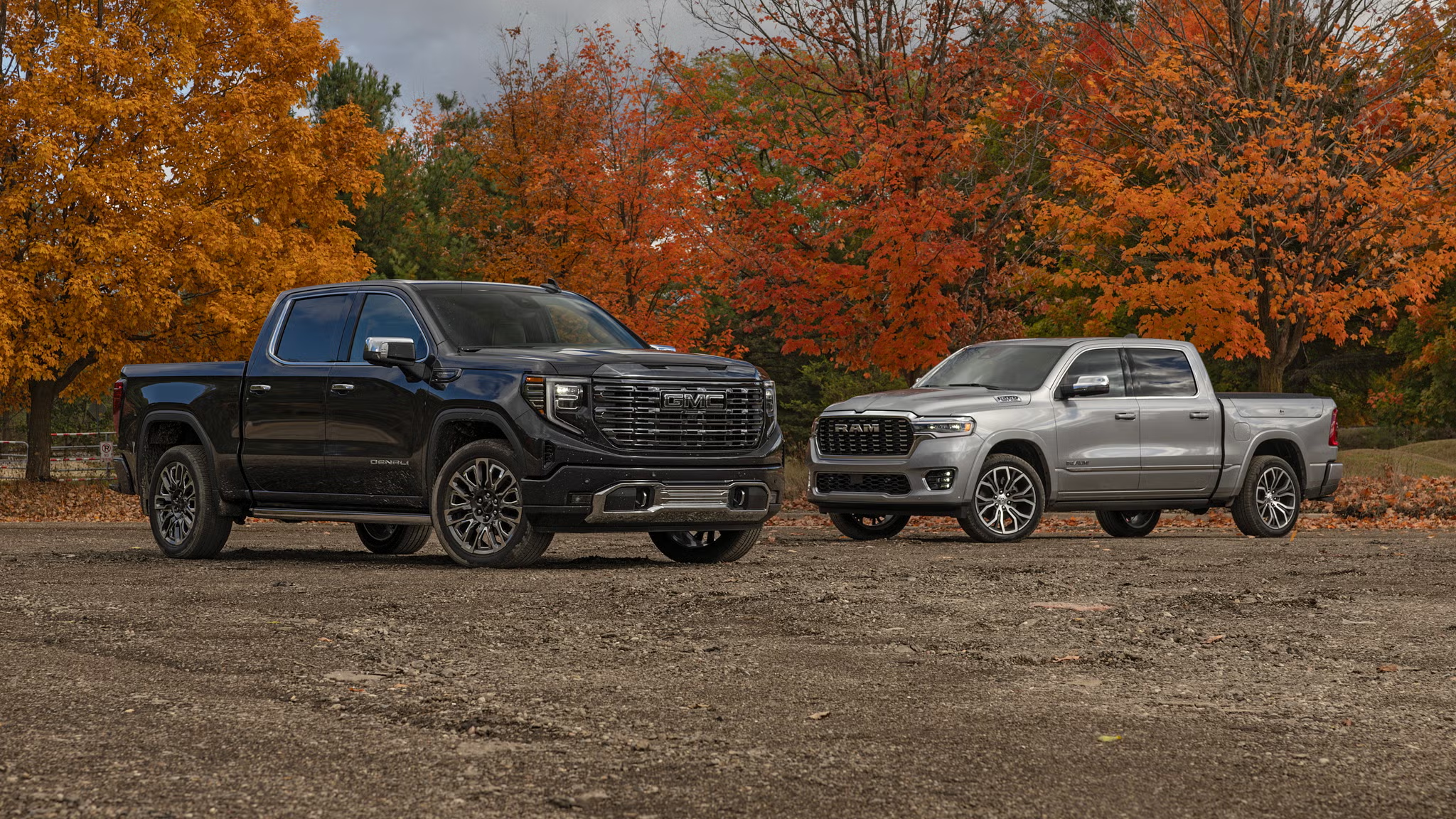

The luxury pickup has borrowed the sedan’s appointments without borrowing its manners. A Ram 1500 Tungsten offers the elaborate seating and expensive upholstery once associated with an executive saloon, then wears them behind a grille intended to look heroic. The same truck can provide limousine-grade seating inside while projecting capability outside. It sells comfort to the occupants and capability to everyone else, allowing the same purchase to tell two quite different stories.
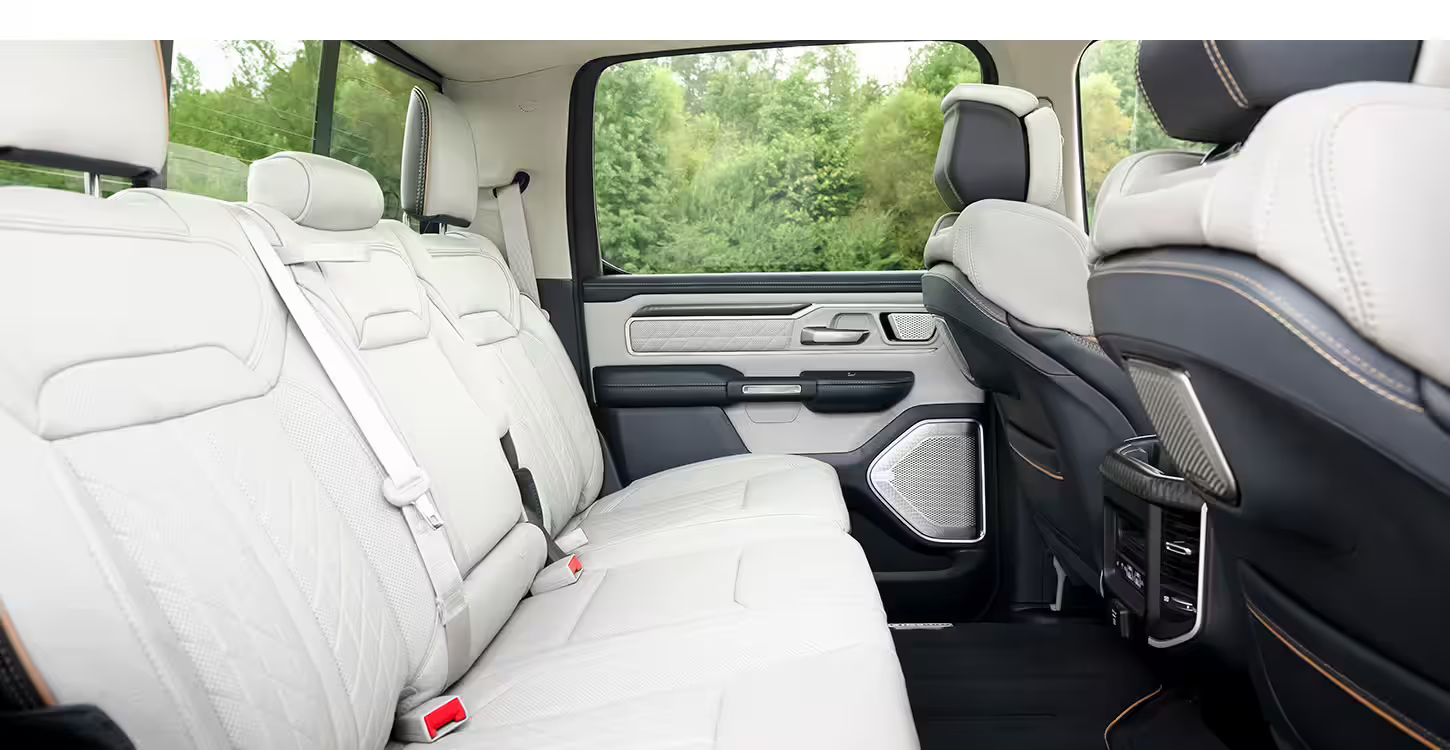

Start with the actual truck rather than a composite of every expensive option in Detroit. The Tungsten belongs to the light-duty Ram 1500 range, not the heavy-duty class. Its front seats have 24-way adjustment, heat, ventilation, and massage, with quilted Natura Plus leather. Those are substantive appointments, not a vinyl bench made respectable by a large screen. Alongside the Rolls-Royce cabin pictured here, the Ram illustrates how far the pickup’s interior brief has traveled. It does not establish that the two cars have equal materials, isolation, or ride quality. The more consequential fact is that such a comparison no longer sounds like a category error.
A buyer who tows regularly can enjoy those seats without compromising the truck’s purpose. Someone whose hardest working day involves a laptop can buy the same cabin and enjoy the association with work. These are possible uses, not diagnoses of the people signing the paperwork. The pickup accommodates both because the expensive interior does not erase the bed. A sedan offers comfort without that visible alibi. The truck lets its owner possess a lounge while displaying a tool.
Luxury as discretion
That distinction matters because one important tradition of luxury was discretion: buying an unusually agreeable private environment without making an equally conspicuous public announcement.

The first Lexus LS400 provides a useful example. Its owner might have chosen it for refinement, price, reliability, its dealer, or simply its appearance. Motive cannot be read from a badge. Nevertheless, the car offered a particular social possibility. It provided flagship accommodation in a relatively plain sedan, without the Mercedes hood ornament or Cadillac’s accumulated ceremonial baggage. To an observer who did not know the car, much of the expenditure could remain inside. Whether that discretion attracted a particular buyer is a separate question.
American manufacturers had offered their own gradations of this choice. A Buick could be substantial and comfortable without making quite the same declaration as a Cadillac. Neither marque was consistently restrained, and no tailfinned Cadillac should be recruited retrospectively into a monastery. Buick and Cadillac occupied different positions on the same continuum of comfort, ornament, recognition, and price.
The upscale pickup adds another combination. It can announce expense to someone familiar with its trim while presenting a broadly practical silhouette to everyone else. It is not proof that its owner is pretending to need a truck, but it helps explain why the luxury cabin and the working body coexist so comfortably in the showroom.
When premium became ordinary
Heated seats, large screens, and leather are easy to transplant into a truck; ride quality, seating geometry, isolation, and discretion are not. A heated seat is a feature. A supportive seat, appropriately shaped and mounted in a quiet cabin with a settled ride, is a system. Manufacturers have become very good at distributing the first without necessarily reproducing the second.

The 2026 Sonata Limited Hybrid, for example, offers leather seating surfaces and heated and ventilated front seats. Such equipment no longer requires a luxury badge. This is a welcome improvement in ordinary transportation, although a ventilated seat in two different cars need not have the same shape, padding, adjustment, airflow, or noise. Nor does a large display tell us how a cabin handles glare, road vibration, or a driver trying to change the temperature. Shared feature names make brochures look more alike than the cars necessarily feel.
Even so, the spread of those features weakens their usefulness as visible distinctions. A buyer comparing photographs can see a wide screen in an ordinary sedan and another in an expensive one. The finer differences require use, attention, or explanation. Size requires none of those things. It remains a comparatively direct way to make the expensive object look different.
From length to height
American luxury did not discover size when a pickup acquired massaging seats. It had already spent decades exploring what could be accomplished with a long wheelbase, an indulgent rear compartment, and enough upholstery to refurnish a modest apartment. The newer development is the combination of that interior ambition with the proportions and public associations of a truck.
The Eldorado Brougham treated expense as an opportunity to produce an unusually elaborate complete car. The Fleetwood Talisman approached indulgence through a different medium: velour, deeply divided seating, and an almost residential attitude toward personal space. The original four-seat Talisman arrangement made a particularly frank trade. It gave up a passenger position to keep the remaining occupants apart. These were not discreet objects in any absolute sense, but much of their extravagance concerned how people inhabited them.
Length alone did not make those cars ride well. Wheelbase, suspension geometry, spring and damper choices, tires, structure, and seat design all contributed, sometimes imperfectly. Their characteristic promise was nevertheless recognizable: settle into a low, broad compartment and let the surrounding world become less intrusive. A long hood was visible expense, but the seating position did not put the driver above the neighboring traffic.
The luxury truck stages its arrival vertically.
A high seating position changes the view from inside, while a tall hood and grille change the view from outside. The truck occupies more of the scene and presents a larger face to whatever is ahead. That can communicate command, although it also has practical consequences that depend on the actual vehicle: climbing aboard, judging its front corners, reaching cargo, and fitting it into ordinary parking spaces. Height is an attribute, not a free improvement. A step that assists entry is also a small admission that entry needed assistance.
Ram makes the intended visual message unusually plain. Its launch description for the redesigned 1500 calls the truck’s appearance “heroic.” The word belongs to the manufacturer, not to a sociological theory imposed afterward. A grille cannot tow anything. It can, however, make towing capacity look like a personality.
A good sedan offers a different set of advantages. Its lower body can make access easier for some occupants and harder for others. Its dimensions, seating, suspension, and control layout can produce a particularly coherent road car without accommodating a separate cargo bed. None of this requires an aristocratic palate. Choosing between a luxury truck and a luxury sedan turns on ride, seating, access, dimensions, towing, cargo, and the public character of the body. Nor is mass-produced truck refinement counterfeit merely because it was achieved with insulation; luxury sedans use insulation too.
The commercial challenge is that many of these distinctions become convincing only after the car has been used. Height makes its argument from across the parking lot.
Truck buyers have their own exacting knowledge of engines, axle ratios, seats, towing equipment, and suspension behavior. The pickup’s body communicates a broad idea of capability even to people who know none of its mechanical particulars. The premium sedan’s finer distinctions often remain invisible to that passerby.
Capability as a status signal
Veblen’s account of conspicuous consumption offers one interpretation of the unused capacity. An expensive object can advertise resources beyond what an immediate task requires. But a photograph of an empty bed cannot establish that capacity is wasted over a year, much less reveal the buyer’s motives. The interesting ambiguity is precisely that the same truck can be a necessary tool, a recreational convenience, an aspirational purchase, and a status object. Those functions need not exclude one another.
Compared with a luxury sedan, the truck also carries an unusually easy explanation for its expense: it can do more. An owner may never use all of that extra capability. The status value lies partly in possessing options. A trailer need not be attached every morning for the possibility of attaching one to have value, practical or otherwise.
For the imagined office worker with a taste for ranch imagery, that possibility becomes part of the attraction. The truck offers a version of an outdoor life without requiring every journey to enact it. A large SUV can make a related promise to a family whose actual requirements occasionally, rather than continuously, fill the available space. Aspirational consumption is not unique to trucks. Most sports cars spend considerable time failing to encounter a circuit.
What distinguishes the luxury pickup is the distance between its working associations and its private appointments. The bed can still carry materials while the driver receives a massage. A truck can carry luxury equipment without compromising its mechanical usefulness. It is simply an exceptionally effective product proposition: retain the recognizable outline of work, then remove as much discomfort from the experience as the selling price will support. Ruggedness becomes something the vehicle supplies rather than something the occupant must endure.
There are also political interpretations of these objects. In her 2018 article “Petro-masculinity,” Cara Daggett examines relationships among fossil fuels, masculine identities, and authoritarian politics. That is an attributed analytical framework, not a finding about the person driving a particular Ram. Its relevance here is limited but useful: vehicles can acquire public associations their owners neither selected nor endorse. Styling provides material for those interpretations; it does not establish an owner’s ideology.
Taste complicates the reading further. In the tradition associated with Bourdieu, preferences can distinguish one social group from another rather than form a universal ladder of quality. A discreet sedan may be admired in one circle and overlooked in another. A particular truck specification can carry distinctions invisible outside its audience. My preference for the sedan’s restraint is therefore a preference with its own cultural baggage, not an exemption from the mechanism. Declining the conspicuous option can itself become a conspicuous form of discernment.
Why manufacturers followed
Manufacturers do not merely stand aside while these meanings develop. They choose where to invest, which variants to advertise, and how far upward to extend the trim ladder.
GM’s 2024 annual report supplies a concrete financial reason. The company identifies full-size combustion pickups and SUVs as the products on which it then recognized its highest profit margins. That does not disclose a margin for every Denali or prove the economics of every rival. When buyers accept expensive versions of an established truck, a manufacturer has a reason to improve those versions, promote them, and cultivate another step above the existing top trim.
The categories themselves require care. EPA’s latest report, with final model-year 2024 data, describes a long movement from sedans and wagons toward SUVs. Its truck category includes many SUVs, not just pickups, and the recent increase in truck SUV share came at the expense of every other vehicle type, including pickups. Those data do not establish that luxury pickups individually caused the luxury sedan’s retreat. They locate the pickup within a wider change in the market. Treating every vehicle regulated as a truck as evidence of demand for a cargo bed would mistake a regulatory definition for a body style.
Within that wider change, the luxury pickup makes a formidable practical offer to the right household. It combines a large passenger compartment, cargo separation, towing capability, and elaborate amenities in one purchase. Against those advantages sit dimensions, access, fuel use, parking, and the ride requirements imposed by the work it is meant to do. A sedan may serve a different household better. The fact that the truck has entered luxury territory does not suspend those tradeoffs; it makes them easier to overlook beneath the upholstery.
From ownership to access
A second development concerns control after the purchase. It is related to the changing luxury experience, although it is neither confined to trucks nor an explanation for the sedan’s decline.
On eligible vehicles, including the F-150, access to the hands-free assistance feature can be bought through a monthly or annual plan, with a separate one-time purchase option offered at vehicle purchase. The driver must still supervise. Here a particular capability depends on commercial terms beyond the presence of its supporting hardware. That is different from saying the whole cabin is rented, that all software requires a subscription, or that the vehicle stops functioning when a plan expires.
For someone who values predictable ownership, the concern is not the symbolism of being able to keep paying. It is knowing what remains available, under which conditions, for how long, and to a subsequent owner. A recurring service can provide something genuinely recurring, such as updated data or ongoing support. It can also make a once straightforward comparison between two cars depend on contracts that deserve more attention than the screen’s diagonal measurement.
Traditional luxury was hardly free of continuing obligations. Maintenance, parts, skilled labor, and fuel always followed the purchase price. The additional question is whether a useful feature depends on the continued permission or operation of a remote provider, and what happens when that arrangement changes. A comfortable seat remains a comfortable seat without an account. A connected feature may have a more complicated answer. The owner should be able to establish the difference before committing to the car.
Discretion and predictable control meet at the same preference: less intrusion. One concerns the attention a car attracts outside; the other concerns the demands it makes inside and over time. Neither has disappeared, and neither belongs exclusively to an old Lexus. But both can be obscured by a luxury sales pitch organized around visible scale, extravagant equipment, and constantly expanding capability.
There is still pleasure in choosing a car that does not introduce its owner. I prefer that possibility to a towering hood, even when the cabin behind the hood is excellent. The preference does not make a truck buyer mistaken. Two equally expensive, well-appointed vehicles can still differ radically in visibility, access, dimensions, and the public associations carried by their body styles.
Actual use eventually tests both stories. The seat must fit, the ride must suit the roads, the passengers must get aboard, and the vehicle must fit where it is parked. The image is easiest to purchase. Living with the dimensions is the longer transaction.

The luxury truck’s interior matters because the comfort is real, not because it proves a universal victory over every old Rolls-Royce. Its success joins amenities with a public form that can signify work, preparedness, and authority. That is a more interesting achievement than simply putting leather in a truck. It gives an expensive object several ways to explain itself, while leaving the occupants free to enjoy appointments that require no practical explanation at all.
The pickup did not single-handedly kill the luxury sedan, and the sedan is not literally dead. Together with SUVs, however, upscale pickups have helped make a tall, outwardly capable vehicle a credible substitute for the traditional executive car. The leather moved into a body that also projects work, preparedness, and capability.
The part of traditional luxury I miss is the freedom to leave that introduction unfinished.


