VI. Paradigm Shift: BMW’s V12 for Rolls-Royce and a Turbo V8 for Bentley

The most revealing development of the E38 era was BMW’s rise from rival to supplier. In the 1990s, Rolls-Royce Motor Cars needed a new generation of powertrains and did not have the internal resources to create them alone. After considering other options, it chose BMW. The future Rolls would take the 5.4-liter M73 V12. Bentley would take a twin-turbocharged 4.4-liter V8 derived from BMW’s M62 and developed with Cosworth. The decision conceded the point without saying so aloud. Rolls-Royce, the old standard, had decided that Munich now built the more modern engines.

The result was the 1998 Silver Seraph with a BMW V12 under its long bonnet, while the contemporary Bentley Arnage received BMW’s twin-turbo V8. The same company that sold a 750iL was now supplying the heart of a Rolls-Royce. A decade earlier that would have sounded like parody. By 1998 it was procurement. In practice it worked. BMW’s drivetrain dragged Rolls into the modern era with the smoothness, silence, and control the marque required, though not without the faint embarrassment of BMW switchgear and electronics being visible to anyone paying attention.

Then Vickers put Rolls-Royce Motor Cars up for sale and the whole thing became farcical. BMW wanted the business and assumed its technical partnership gave it a credible path. Volkswagen simply bid more for the factory, the cars, and the physical assets. It looked like BMW had lost. It had not.

What Volkswagen had not properly secured was the name. Rolls-Royce plc, the aerospace company that actually controlled the Rolls-Royce trademark and double-R emblem, preferred BMW and licensed the name accordingly. Volkswagen had Crewe, the grille, and the mascot, but not the right to write Rolls-Royce on the invoice after 2002. Few episodes in automotive corporate history have looked more like a boardroom farce written by someone with a grudge.

The resulting compromise was as odd as the oversight that produced it. Volkswagen could keep using the name briefly, BMW would continue supplying engines and key components, and everyone would pretend the arrangement made strategic sense. In reality, Volkswagen had bought a luxury-car company that remained mechanically dependent on its rival.

From 1998 onward, BMW’s V12 powered the Silver Seraph, the first 12-cylinder Rolls-Royce since the Phantom III. BMW had gone from offering no V12 road car before 1987 to supplying Rolls-Royce’s modern one barely 11 years later. Volkswagen moved quickly to end Bentley’s dependence. It reengineered the Arnage around the ancient 6.75-liter pushrod V8 and called the result the Red Label, partly to restore technical independence and partly to restore pride.

That conversion was not elegant. The older British V8 was heavier, rougher, thirstier, and harder on the chassis and brakes. But it restored Bentley’s lineage, or at least the appearance of it. The BMW-powered Green Label quietly faded away, while Bentley under Volkswagen later embraced the W12 as its own corporate answer to 12-cylinder prestige. It was clever and effective. It was also not a V12 in the old sense.

For BMW, the entire episode was vindication. Its engines had become sufficiently refined that Rolls-Royce relied on them, and the technical exchange worked in both directions. Ultra-luxury development sharpened BMW’s own thinking about ride isolation, NVH, and the sort of details wealthy buyers notice long after launch-control statistics stop mattering. By the late 1990s BMW was no longer merely challenging Rolls-Royce in engineering terms. It was preparing to become Rolls-Royce.
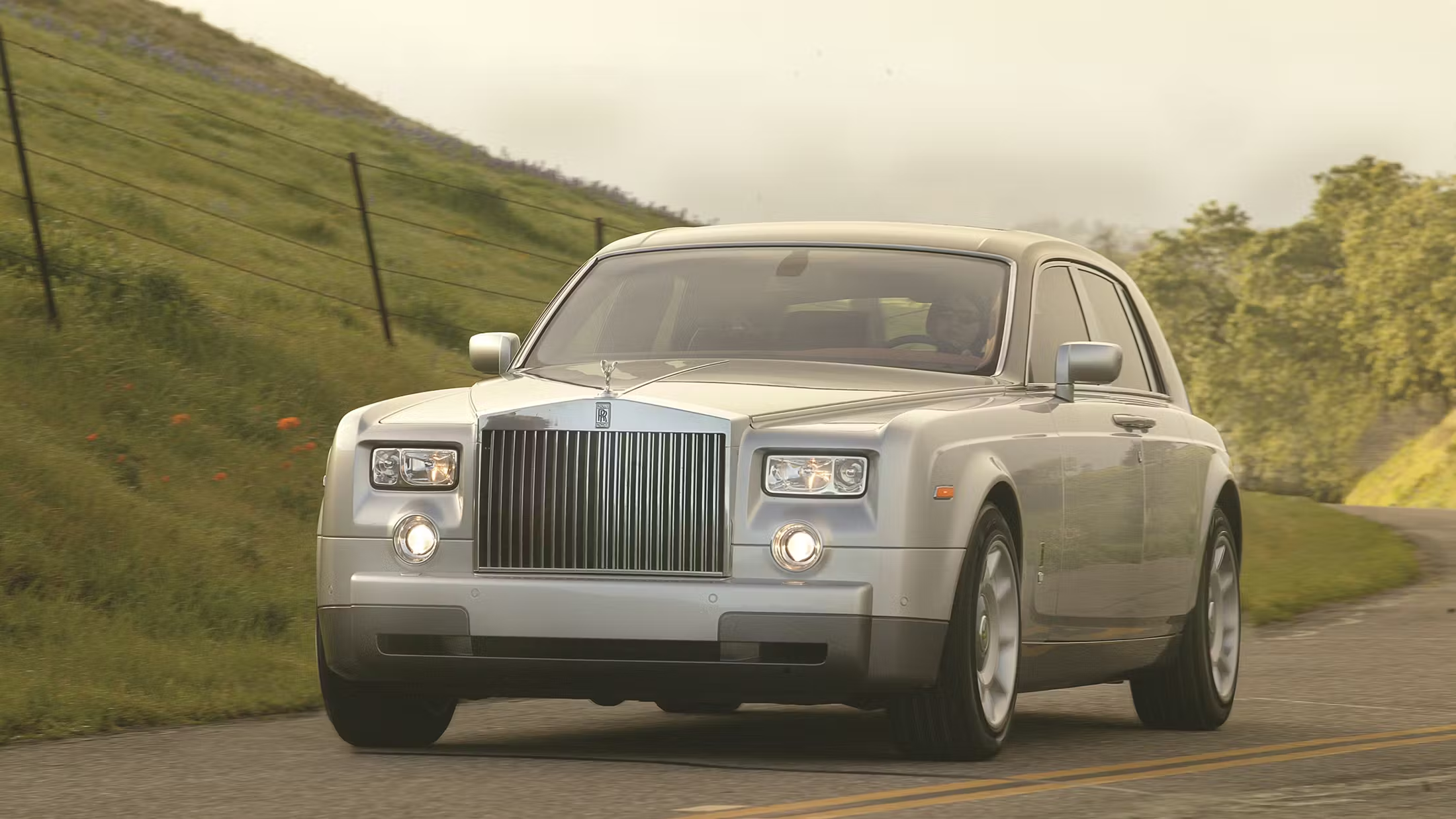
When BMW formally took over Rolls-Royce in 2003, it knew the first Goodwood-era car had to settle every lingering doubt at once. The Phantom VII did exactly that. It was not a tarted-up BMW. It was vast, formal, and technically serious enough to quiet the obvious doubts.

The engineering beneath it was entirely contemporary. An aluminum spaceframe, immense structural rigidity, a 6.75-liter BMW-designed V12, and performance that would have been remarkable even in a much smaller car made the Phantom more than an exercise in brand theater. It was BMW proving that its understanding of modern flagship engineering could operate at the absolute top of the market without losing the character of the marque it had inherited.

The Phantom’s success gave BMW a template. Extended-wheelbase Phantoms, coupes, convertibles, then the smaller Ghost followed, and every one drew on BMW powertrain expertise. The Ghost, Wraith, and Dawn carried BMW-derived twin-turbo V12s. The later Phantom VIII and Cullinan moved to a new aluminum architecture co-developed within BMW Group. Rolls-Royce’s modern revival was British in image and execution, but Bavarian in the places that mattered most.

That integration is the real story. Under BMW, Rolls-Royce grew without becoming diluted. Production methods modernized. Sales expanded. Electric development entered the plan. Yet the brand’s essential exclusivity remained intact. That is rarer managerial work than most acquisition decks ever imagine.

The BMW V12 and the Rolls-Royce/Bentley split now read as a single case study in how power shifts inside the luxury car industry. Rolls-Royce once built engines others revered. By the late 1990s it needed an engine from BMW. In the 21st century, BMW engines not only powered Rolls-Royces but helped define the modern standards of refinement those cars were expected to meet. Bentley, meanwhile, reestablished itself on a different path under Volkswagen. Both brands survived. Both were reshaped. BMW, more than anyone else, forced the issue.
In the end, Rolls-Royce and Bentley emerged stronger precisely because they stopped pretending to be the same sort of company. Rolls-Royce became the modern standard for ultra-luxury again, this time with BMW engineering beneath the ceremony. Bentley became the faster, louder, more extroverted house. The late-1990s struggle over Crewe and the double-R did not just rearrange corporate ownership. It rearranged the logic of British luxury motoring for the next generation.