
Luxury used to be something you could feel without having to explain it. In 2026, luxury is increasingly something you can justify in public while you enjoy it in private. Pickups and full-size SUVs have climbed into price territory once owned by flagship sedans, not because they offer rare technology, but because they offer the most legible status signal left: size, height, and dominance—wrapped in the moral camouflage of “utility.” This isn’t the first era of big American luxury; Cadillacs proved long ago that America will pay for acreage. What’s new is verticality, the social theater of towering hoods and command seating, and the way software and subscriptions now turn “ownership” into an ongoing access fee. Feature parity flattened the old luxury checklist, so the market moved to what can’t be replicated cheaply: space, narrative legitimacy, and post-purchase control.


You open the door of a six-figure heavy-duty pickup and the first shock is not the screens. It’s the softness. The thickness of the leather. The depth of the carpet. The way the seat does not merely support you but performs for you—heat, ventilation, massage, memory, the whole choreography—while the cabin seals out the world with the indifference of a bank vault. The second shock is how familiar this has become. A Ford Super Duty dually in its top trim can be configured into a price bracket that used to require a flagship German sedan or an actual limousine. A Ram 1500 in its newest top-line trim, Tungsten (above left) can sit around the threshold where “luxury” used to begin as a category rather than a mood. In the 1990s, a Rolls-Royce interior (above, right) was a sermon about materials and hush; today the sermon is about volume and theater, and you can hear it in the way a pickup door closes like architecture.

A rancher signs for one because it fits a life that actually asks for tow ratings and payload. An office worker signs for one because the truck offers a more persuasive story than a sedan ever could. On screen, John Dutton rules Montana from behind the wheel of a Ram while his daughter arrives in a Bentley Continental as if it were jewelry—beautiful, expensive, and somehow less authoritative. That inversion is the whole point. The truck reads as power. The Bentley reads as decoration. Once you notice this, you can’t unsee it: luxury didn’t disappear, it changed costumes and learned a new language.
The old language of luxury was not just comfort. It was discretion. It was the ability to move through the world without being introduced by your purchase.

That’s what people forget when they try to explain quiet luxury as engineering purity or disciplined restraint. The buyer who chose a Lexus LS400 over a Mercedes flagship was not necessarily making a technical argument, even if the Lexus deserved one. They were making a social one. The Lexus had no hood ornament, no inherited script, no century of shorthand. It was expensive and excellent, but it did not announce itself with the same clarity as a German badge. You could arrive without the car speaking first. You could buy the experience and decline the performance.
Go back further and the same instinct shows up in older American hierarchies. There was a time when Cadillac was the pointed statement and Buick was the softer one. Cadillac projected success outward; Buick let you sit inside it. Neither was anonymous in an absolute sense—nothing that large ever is—but one carried more theater than the other. Luxury, then, wasn’t only what you had. It was what you could avoid signaling.
That version of luxury is now an endangered species because the market no longer rewards the desire to be unread. The contemporary buyer is not trying to disappear. The contemporary buyer is trying to be recognized instantly, and recognized in a way that can’t be dismissed as vanity. That’s why the pickup wins. It is the most efficient status object ever built because it solves the modern luxury problem: it provides maximum signal with maximum plausible deniability.
If you want to understand why the old luxury checklist collapsed, don’t start with government-mandated safety tech or the latest driver-assist acronym. Nobody experiences that as luxury. Start with the interior, because that’s where the flattening is visible.

In 2026, the feature economy has been strip-mined. What used to be gated behind premium brands—heated seats, ventilated seats, big infotainment screens, CarPlay and Android Auto, stitched-looking dashboards, ambient lighting—has been pushed down-market until the cabin language of “premium” is barely distinguishable from the cabin language of “competitive.” Mainstream brands sell leatherette with confidence. Entry-level sedans and crossovers mimic the stitched aesthetic that used to be a luxury tell, because the visual sign is cheap to replicate and customers have been trained to shop by the photograph. The result is a strange democratization: more people get comfort than ever, but fewer people can use comfort as a class marker.
When everyone has the same screens, the same interface, the same phone mirroring, the same “premium” textures stamped into plastic, luxury has to relocate. It doesn’t vanish. It moves to what can’t be handed out without changing the entire object.
It moves to form.
This is where it’s easy to get the history wrong by pretending luxury “found” size in the mid-2020s, as if America hadn’t been worshipping bigness since the Eisenhower years. The truth is that size has always been part of luxury here. The difference is what kind of size, and what that size is for.
Mid-century American luxury was shamelessly large, but it was large in a horizontal way. The great Cadillacs of the 1950s and 1960s, the hand-finished oddities and halo cars, the top-shelf interiors with their obsessive upholstery and their sense of being a moving living room—these weren’t small cars. The Eldorado Brougham exists as a kind of proof-of-concept that America once understood luxury as a grand object: rare, expensive (in its own era’s terms), and built to make European restraint feel like a different religion. The Fleetwood Talisman stands as another kind of proof, less about coachbuilt exclusivity and more about the fetish of interior softness and personal space, a four-seat lounge where luxury was expressed as square footage and texture.
Those cars were long so they could glide. Their bigness was meant to make motion feel like separation from the world, not conquest of it. They sat low. They emphasized ride. They made you feel insulated, not elevated.
The modern luxury truck is big for a different reason. It’s big because it is more visible.
Verticality is the defining geometry of contemporary luxury. Height produces immediate legibility. A tall truck reads in a way a low sedan never can because it changes the relationship between vehicles on the road. It fills mirrors. It stares over traffic. It turns the driver into someone who looks down rather than across. Even when the ride is soft and the interior is decadent, the exterior posture is not comfort. It is command.
The culture has been trained to interpret that posture as authority. You don’t need to know the trim name to understand the signal. You can read it at speed, from a distance, with no context. That’s why it works.
The sedan, by contrast, still asks to be interpreted. Its best qualities live in proportion, composure, and resolution—the subtle coherence of things that were designed to move well rather than merely occupy space. Those qualities are real, but they require attention and a trained palate. They assume a viewer who can feel why a well-sorted suspension matters, why silence achieved through engineering is different from silence achieved through sheer mass and insulation. The market is no longer built around that kind of viewer.
It’s not that sedans became worse. It’s that interpretation became a losing strategy.
The pickup’s genius is that it does not require anyone to be sophisticated. It does not require anyone to know anything. It simply arrives as an object of mass and height, and the meaning attaches itself automatically.
This is where Veblen stops being a stale reference and becomes a live diagnostic tool. The luxury pickup is a nearly perfect expression of honorific value because it doesn’t just signal that you spent money. It signals that you can afford waste while claiming necessity. The overstated capability functions as cover for the overstated purchase. The inefficiency is not accidental; it is part of the proof. A large truck used lightly is not a tool failing its purpose. It is a status object succeeding at its real purpose: public demonstration that normal constraints don’t bind you.
A luxury sedan signals honorific value directly. It admits what it is. That openness has become a liability in an era where people want their consumption to seem earned, required, even virtuous. The truck offers an escape hatch: you can buy excess while telling yourself you bought responsibility.
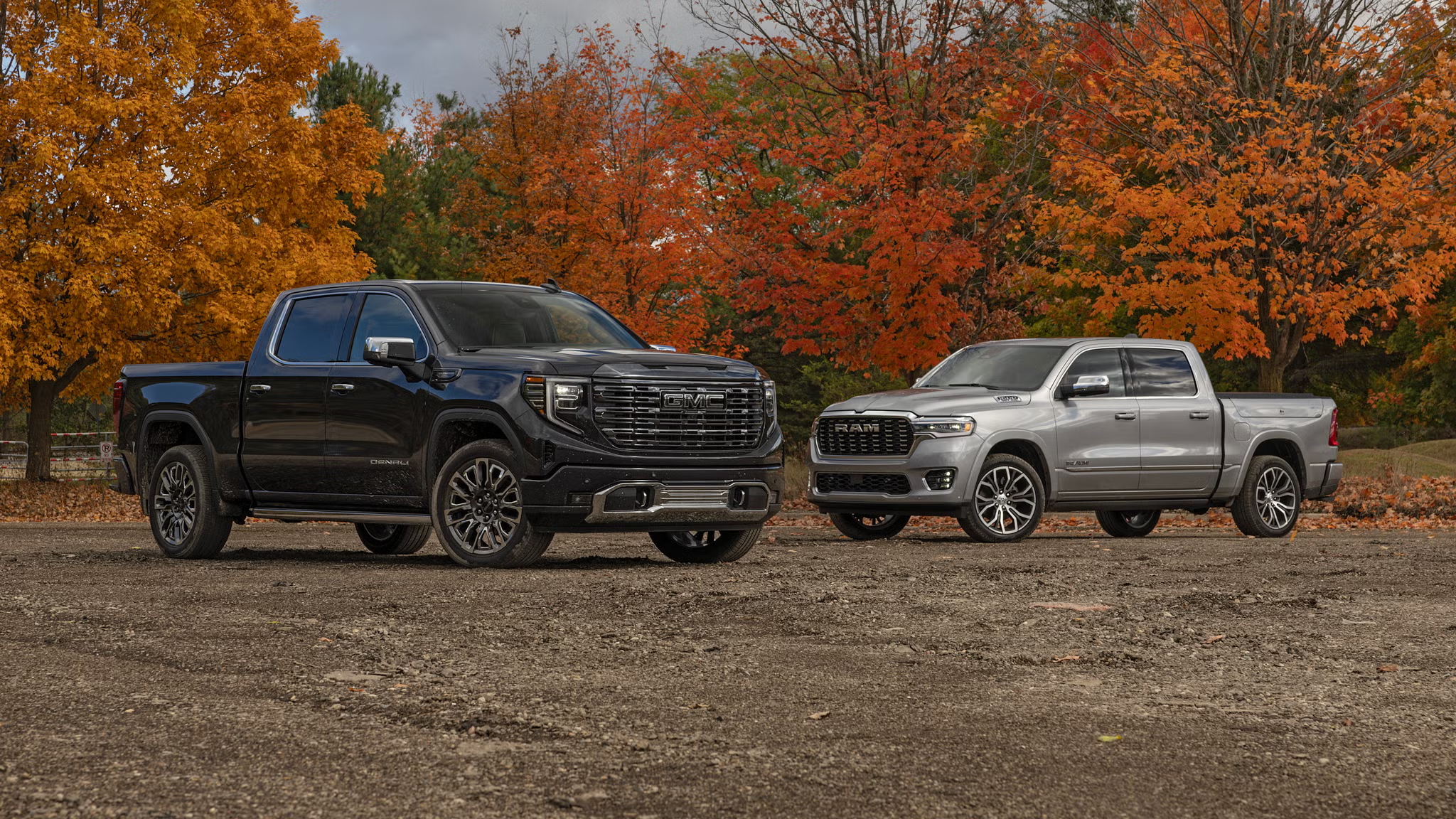
This is why the upscale truck is the preferred choice of the aspirational cowboy—the person who in a different decade would have stretched for a German badge but now chooses a Ram Tungsten or GMC Denali because it delivers the same interior indulgence while allowing a different self-image. It is also why the banker can trade the old executive sedan for an enormous SUV and call it family practicality. The story is the product as much as the leather.
It helps that the truck is already a costume with deep cultural packaging. The cowboy imagery is not incidental. It is the American fantasy of authenticity sold back to people who live far from fence lines. A truck lets you cosplay as labor while living inside luxury that is richer than what the previous century’s rich actually sat in. It is a working-class silhouette with an upper-class cabin, and that contradiction is exactly why it sells. You get to perform ruggedness without suffering it.
There is an uglier layer too, one the culture pretends not to notice while it benefits from the clarity. The modern truck has become a political-aesthetic object. “Petro-masculinity” names part of that phenomenon: a performance where fossil fuel consumption, physical bulk, and aggressive styling become proxies for cultural power. Not every truck owner participates in that performance, and reducing everyone to a caricature is lazy. But the car doesn’t care what you intend. It cares what you project, and the truck projects. Lift kits, hostile grilles, exaggerated hood lines, the visual language of armor—these are not neutral design choices. They are signals that attach themselves to the vehicle whether the owner wants them or not. The truck has become an easy shorthand because it is designed to be legible.
Bourdieu explains why this legibility matters even when everyone pretends it doesn’t. Taste is not simply personal preference; it’s a social instrument. What counts as “good” is shaped by the group with the authority to call it good, and people learn those preferences as naturally as they learn accents. In a world where the luxury checklist has been normalized, taste becomes the differentiator again—but now taste is not about coachbuilt proportions or restraint. It is about choosing the correct kind of large vehicle, the correct stance, the correct trim, the correct package. The high-status choice is no longer a low, quiet sedan that refuses to speak. The high-status choice is the correct form of dominance that can still be defended as prudence.
This cultural shift didn’t happen in a vacuum, and pretending it did lets the industry off the hook. Automakers pushed the market toward trucks and SUVs because trucks and SUVs are financial machines.
Large vehicles are where margins concentrate. They are where trim ladders can climb without breaking the story. They are where the same technology can be sold for more money with less resistance. A plush interior costs money no matter what it’s installed in, but it’s far easier to ask premium prices when the object is physically large, visually imposing, and culturally framed as “capable.” Once the profit logic is in place, marketing and product planning follow it like gravity. The pickup becomes a platform for selling excess because the pickup can absorb excess without looking absurd. A sedan stuffed with luxury can look like someone trying too hard. A truck stuffed with luxury looks, to many buyers, like someone preparing for life.
Regulation has also made this migration smoother than it should be. U.S. efficiency standards scale by vehicle footprint rather than treating all vehicles as the same target, which means larger footprints are often held to different curves than smaller ones. You don’t need to turn this into a conspiracy theory to see what it does: it reduces the penalty for building large, and it gives manufacturers room to concentrate resources where the profits already are. The law doesn’t force the luxury truck into existence, but it helps the industry prefer the category that already prints money.
The result is that a truck doesn’t just replace the luxury sedan. It invades its territory and makes a stronger claim there. It offers a more spacious cabin, a higher seating position, and a more socially defensible story, while also delivering the same comfort amenities and the same digital ecosystem that used to justify luxury pricing. Once the old sedan monopoly on comfort and quiet is gone, the sedan is left with subtleties. Subtleties do not dominate markets.
There is one more shift that makes the current era feel like the end of an older luxury idea: luxury is no longer strictly a purchase. It is increasingly a relationship measured over time.
As cars become software-defined, the locus of luxury moves from what you bought to what you are allowed to access. The cabin becomes a billing surface. Features become toggles. Capability becomes something that can be unlocked, withheld, updated, revoked, or sold back to you. The old luxury model was simple: pay more once and you receive more permanently. The new model is that the car is never finished, and the transaction never ends.
This isn’t just about heated seats becoming a punchline. It’s deeper than that. Metered features turn luxury into the ability to keep paying. They turn ownership into membership. The highest-status condition is not merely having the hardware, but having continuous, unquestioned access to whatever the platform decides is premium this year. In that world, luxury is no longer a thing you possess so much as a gate you pass through repeatedly.
This is the part of modern luxury that feels most revealing, because it connects back to what luxury once promised at its best: control. The old luxury car gave you control over your environment—quiet, comfort, isolation—without demanding anything back except the purchase price and maintenance. The new luxury model increasingly treats control as a service, and services are, by design, revocable. When a company can lock or unlock aspects of your car, luxury becomes less about the object’s inherent qualities and more about the terms of your access. The car becomes a managed device, not a finished good, and the wealthy are simply the people least likely to notice the management.
This also reframes the Lexus-era idea of quiet luxury as anonymity. Anonymity requires the option to refuse the social game, to slip through without being processed by someone else’s assumptions. That kind of luxury is harder now, not because quiet cars don’t exist, but because the entire market’s status language has shifted from understatement to dominance, and the entire industry has shifted from selling finished objects to selling ongoing access.
The irony is that true quiet luxury in 2026 might belong to the person who can afford not to participate in the modern signaling arms race at all. The person who chooses a car that does not introduce them. The person who rejects the towering hood, the hostile face, the just-so story of preparedness. That refusal has become its own form of distinction precisely because it is no longer the default behavior of wealthy buyers.
But the mass market doesn’t run on irony. It runs on experience.
That is why the six-figure truck interior matters. It isn’t just an absurd configuration. It’s the clearest clue to what luxury means now. Luxury, after feature parity, is not a list of conveniences. It is space, dominance, narrative legitimacy, and control over access. It is the ability to buy something enormous and call it sensible. It is the ability to sit in a cabin soft enough to shame an old Rolls while the exterior projects capability, aggression, and cultural belonging all at once. It is the most successful merger of comfort and costume the industry has ever produced.
The luxury sedan didn’t die because the truck became better at being a sedan. It died because the culture stopped rewarding what the sedan was good at. The sedan offered refinement that required interpretation, and a kind of luxury that could choose silence. The truck offers luxury that speaks immediately, loudly, and with the benefit of a story that lets the buyer feel justified.
That’s the real end of traditional luxury. Not the end of expensive cars, not the end of comfort, not the end of indulgence, but the end of luxury as the right to be unread.